Monday, November 5, 2012

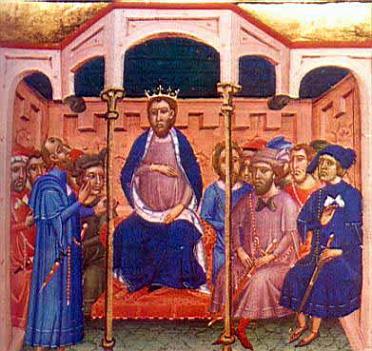
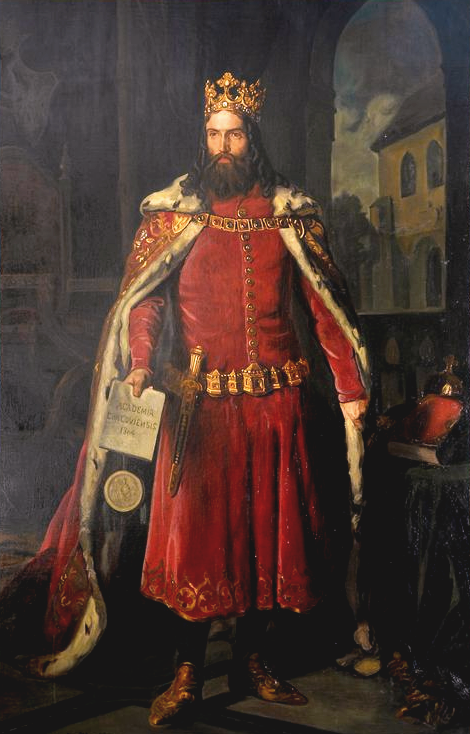
[November 5] Casimir III, king of Poland

Local Name: Kazimierz Wielki
Surnamed: "The Great"
Parents: Wladyslaw I, king of Poland, Hedwig of Kalisz
Born: 30 April 1310
House: Piast
Spouse(s): (1) Aldona, daughter of Gediminas, grand duke of Lithuania, and Jewna, then (2) Adelheid, daughter of Henry II, landgrave of Hesse, and Elizabeth of Meissen, then (3) Christina, then (4) Hedwig, daughter of Henry V, duke of Zagan, and Anna of Mazovia
Predecessor: Vladislaus I
Reign: 1333 – 1370
Brief: Though now considered the only "great" king of Poland, when he ascended the throne his crown was in peril. Wars had ravaged the land and the Polish economy. As king, he expanded the country southward into the Ukraine, and worked on improving the economy. Much of his reign was dominated by warfare, though Poland itself was relatively peaceful during the period. Castles were built around the marches of Poland and Casimir personally reformed the Polish army and civil service. He founded the University of Krakow to better educate his officials. Facing a lack of an heir, he designated Louis I of Hungary as his successor. An illegitimate son was born a few years earlier, but he failed to claim the throne. To avoid warfare with the Mongols, Casimir III paid tribute to the Golden Horde, which satisfied them for a time. Casimir died in 1370 leaving the country to Louis in personal union with the kingdom of Hungary, though his sister Elizabeth ruled as regent in Poland for many years. Casimir III was the last Piast king.
Date of Death: 5 November 1370
Successor: Louis

Sunday, November 4, 2012

[November 4] Thieu Tri, emperor of Vietnam

An imperial edict signed by Thieu Tri
Local Name: Nguyễn Phúc Miên Tông
Parents: Minh Mang, emperor of Vietnam, and Ho Thi Hoa
Born: 6 June 1807
House: Nguyen
Predecessor: Minh Mang
Reign: 1841 – 1847
Brief: As an early emperor of Vietnam, Thieu Tri was a conservative, focusing on isolationism and Confucianism in the face of Western imperialism. He was suspicious of outsiders despite a desire to learn about them. The United Kingdom and France were both pushing into Indochina from the west, and Christian missionaries, generally Spanish and French continued to appear in Vietnam, despite bans in place against them. Tri began imprisoning the missionaries, and France responded. In 1843, they invaded Indochina to recover their missionaries and ensure the safety of French explorers. The United States got involved in 1845 when the USS Constitution attempted to free a missionary who was a multiple offender. Two years later, France reached Tourane, a major Vietnamese city, and demanded that missionaries be released and that Tri cease his persecution of them. When Tri ignored the request, the French attacked and destroyed all the coastal defenses of Vietnam as well as much of the Vietnamese fleet. Tri responded by issuing an execution order, which his men fortunately did not put into effect. Tri died shortly afterwards. Not a single missionary was executed during his reign despite his threats.
Date of Death: 4 November 1847
Successor: Tu Duc

Other Monarchs Who Died Today:
  • Khalil Sultan, ruler of Transoxonia (1411)

Saturday, November 3, 2012

[November 3] Peter II, king of Yugoslavia

Local Name: Petar II Karađorđević (Петар II Карађорђевић)
Parents: Alexander I, king of Yugoslavia, and Maria of Romania
Born: 6 September 1923
House: Karadordevic
Spouse(s): Alexandra, daughter of Alexander I, king of Greece, and Aspasia Manos
Predecessor: Alexander I
Reign: 1934 – 1945
Brief: Peter was still in school in England when his father died in 1934, elevating the boy to the kingdom of Yugoslavia. His cousin, Paul, ruled in his name with a regency council until 1941. With few options available to them during World War II, Peter's government chose to join the Tripartite Axis in 1941. Two days later, though, Peter overthrew the pro-German government with the aide of the British and proclaimed himself of age to rule the country. Germany retaliated by attacking Yugoslavia and Greece in Operation Punishment. The government surrendered to the joint German, Bulgarian, Hungarian, and Italian invasion on April 17th. Croatia, Montenegro, and Serbia were all broken off to form puppet governments for its conquerers. Peter fled to Greece and then Palestine, eventually joining the exiled government ministers of half of Europe in London. While in the UK, Peter completed his education at Cambridge and joined the Royal Air Force. Civil war broke out in Yugoslavia as pro-communist Partisans fought pro-monarchy royalists, with the latter often collaborating with the Axis powers. Winston Churchill finally convinced the Allies to support the Partisans in order to win the war. Josip Tito was appointed commander-in-chief and prime minister. In the months after the war ended, Yugoslavia deposed Peter II. The young man moved to the United States and died in 1970 from complications from a liver transplant. He remains the only European monarch buried in US soil.
Date of Death: 3 November 1970
Successor: Alexander (as pretender)

Other Monarchs Who Died Today:
  • Constantius II, emperor of Rome (361)
  • John III, emperor of Constantinople (1254)

Friday, November 2, 2012

[November 2] James II, king of Aragón

Surnamed: "The Just" (El Justo)
Parents: Peter III, king of Aragón, and Constance of Sicily
Born: 10 August 1267
House: Barcleona
Spouse(s): (1) Isabella, daughter of Sancho IV, king of Castile, and María de Molina, then (2) Blanche, daughter of Charles II, king of Naples, and Maria of Hungary, then (3) Marie, daughter of Hugh III, king of Cyprus, and Isabella of Ibelin, then (4) Elisenda, daughter of Pedro I, lord of Altona, and Gisela d'Abarça
Predecessor: Alfonso III
Reign: 1291 – 1327
Brief: Inheriting Sicily from his father in 1285, James II rose to claim the entire Aragonese empire in 1291 when his elder brother, Alfonso III, died. As one of his earliest actions, James ended the feud over Sicily with Charles II of Anjou by ceding to him Sicily. Unfortunately, the Sicilian nobles elected James' brother, Frederick, rather than Charles. The pope requested that James and Charles remove Frederick, investing James with the kingship of Sardinia and Corsica as an enticement. James, however, never moved to depose his brother. In 1295, James returned the Balearic Islands to his uncle, James II of Majorca. But three years later, the Aragonese king demanded to be recognized as the overlord of the islands. An attack on Murcia in 1296 gained him access to Granada and all its wealth, angering the Castilians, though avoiding any lasting grudge. He reigned from Aragón for the rest of his life and died in 1327.
Date of Death: 2 November 1327
Successor: Alfonso IV

Other Monarchs Who Died Today:
  • Peter III, king of Aragón (1285)
  • Maximilian III, archduke of Austria (1618)

Thursday, November 1, 2012

[November 1] Charles II, king of Spain

Surnamed: "The Hexed" (El Hechizado)
Parents: Philip IV, king of Spain, and Mariana of Austria
Born: 6 November 1661
House: Habsburg-Spain
Spouse(s): (1) Marie Louise, daughter of Philippe I, duke of Orléans, and Henrietta of England, then (2) Maria Anna, daughter of Philip William, elector of the Palatinate, and Elisabeth Amalie of Hesse-Darmstadt
Predecessor: Philip IV
Reign: 1665 – 1700
Brief: Although he ruled a vast empire spanning all of Spain, the Low Countries, southern Italy, and much of the New World, the infamy of Charles II was his medical condition. Born with mandibular prognathism (the Habsburg Jaw) and unable to chew, Charles also suffered from an enlarged tongue and other ailments resulting from many generations of inbreeding. His mother, Mariana, ruled during much of his reign, from his minority through many period of poor health. The Spanish court vacillated between French and Austrian influences with Charles generally being ignored. By the end of his life, Charles lived in seclusion, becoming hypersensitive and easily angered. He resolved the succession of Spain on a French grand-nephew, Duke Philip of Anjou, before disappearing entirely from the public. When he died in 1700, the coroner was baffled at how he had lived for so long, finding little of substance left within the dead king's body. Charles II's death prompted the War of the Spanish Succession in 1701 which would last fourteen years as countries fought over the unmanageably large Spanish Empire.
Date of Death: 1 November 1700
Successor: Philip V

Other Monarchs Who Died Today:
  • Richard, duke of Burgundy (921)
  • Henry I, duke of Bavaria (955)
  • Amadeus VII, duke of Savoy (1391)
  • John V, duke of Brittany (1399)
  • Alexander III, tsar of Russia (1894)

Labels

[brief] (102) female monarch (31) Capet (26) [abbreviated] (19) Roman Empire (17) Great monarchs (16) Japan (15) Papacy (15) England (13) saints (13) France (11) Portugal (11) [Missing Deaths] (11) Habsburg (10) Sweden (10) Byzantine Empire (9) Carolingian (9) China (9) Hohenzollern (9) Oldenburg (9) Holy Roman Empire (8) Japan (dynasty) (8) Aragón (7) Austria (7) Denmark (7) Electorate (7) Ethiopia (7) Hungary (7) Navarre (7) Norway (7) Romanov (7) Russia (7) Saxony (7) Scotland (7) Wettin (7) Wittelsbach (7) Bavaria (6) Burgundy (6) Egypt (6) Italy (6) Lorraine (6) Luxembourg (6) Persia (6) Poland (6) Sicily (6) Spain (6) Valois (6) Capet-Burgundy (5) Franks (5) Germany (5) Plantagenet (5) Prussia (5) Quraish (5) Solomon (Ethiopia) (5) Tuscany (5) Anjou (4) Aquitaine (4) Barcelona (dynasty) (4) Bohemia (4) Brittany (4) Burgundy-Aviz (4) Burma (4) Capet-Valois (4) Castile (4) Constantinople (Patriarchate) (4) Habsburg-Lorraine (4) Holstein-Gottorp-Romanov (4) India (4) Ireland (4) Jerusalem (4) Jiménez (4) Kiev (4) Mongolia (4) Naples (4) Netherlands (4) Normandy (4) Osman (4) Ottoman (4) Palaeologos (4) Savoy (4) Savoy (dynasty) (4) Trastámara (4) Wales (4) Afghanistan (3) Albania (3) Bagrationi (3) Banu Hashim (3) Blois (3) Borjigin (3) Bourbon (3) Brabant-Hesse (3) Brandenburg (3) Capet-Bourbon (3) Cologne (3) Croatia (3) Cyprus (3) Disney (3) Fairhair (3) Georgia (3) Gwynedd (3) Hainaut (3) Hesse (3) Hohenstaufen (3) Holland (3) Holstein-Gottorp (3) Inca (3) Islam (3) León (3) Limburg (3) Lithuania (3) Livonia (3) Lothier (3) Macedonia (dynasty) (3) Mainz (3) Mann (3) Medici (3) Morocco (3) México (3) Nassau (3) Nguyễn (3) Serbia (3) Stuart (Stewart) (3) Toungoo (3) Tudor (3) Turkey (3) Vaudemont (3) Vietnam (3) Welf (3) Wessex (3) published articles (3) Abberfraw (2) Aberffraw (2) Alexandria (patriarchate) (2) Angevins (2) Anglo-Saxon (2) Ardennes-Metz (2) Auvergne (2) Ayyubid (2) Basarab (2) Bernadotte (2) Billung (2) Boulogne (2) Brabant (2) Bruce (2) Burgundy-Bragança (2) Caliphate (2) Cilicia (2) Constantine (2) Crovan (2) Denmark (Dynasty) (2) Draculesti (2) Dreux (2) Dunkeld (2) Dutch Republic (2) Estridsen (2) Flanders (2) Florence (2) Further Austria (2) Greece (2) Habsburg-Spain (2) Hanover (2) Hardrada (2) Hauteville (2) Hawai'i (2) Ivrea (2) Joseon (2) Karadordevic (2) Konbaung (2) Korea (2) Maya (2) Merovingian (2) Milan (2) Ming (2) Monaco (2) Nassau-Orange (2) Nassau-Weilburg (2) Norman (2) Novgorod (2) Orange (2) Ottonian (2) Piast (2) Piedmont-Savoy (2) Poitiers (dynasty) (2) Robertian (2) Romania (2) Rurik (2) Sardinia (2) Saxe-Coburg-Gotha (2) Seljuk (2) Siam (2) Syria (2) Teutonic Knights (2) Thailand (2) Theodosian (2) Thuringia (2) Timurid (2) Tokugawa (2) United Kingdom (2) Valois-Burgundy (2) Vandal (2) Venice (2) Visconti (2) Vladimir (2) Wallachia (2) Württemberg (2) York (2) Yugoslavia (2) Zeeland (2) the Britons (2) 18th Dynasty (Egypt) (1) Abbasid (1) Adal (1) Agiad (1) Akinyele (1) Al Khalifa (1) Al-Said (1) Alawiyya (Egyptian) (1) Albret (1) Algeria (1) Algonquian (1) Amber (1) Angola (1) Anjou (dynasty) (1) Anjou-Hungary (1) Ansbach (1) Antonia (1) Antonine (1) Apulia (1) Arabia (1) Armenia (1) Arpad (1) Arsacid (1) Asen (1) Ashikaga (1) Athens (1) Avesnes (1) Avignon Papacy (1) Aviz-Beja (1) Aztec Empire (1) Baden (1) Bahrain (1) Balti (1) Barakzai (1) Barazkai (1) Barcelona (1) Battenberg (1) Belgium (1) Bengal (1) Berg (1) Berg (dynasty) (1) Bernicia (1) Bharatpur (1) Bhutan (1) Bjelbo (1) Bonaparte (1) Bonde (1) Bonngau (dynasty) (1) Borghese (1) Borja (1) Bosnia (1) Bourbon-Two Sicilies (1) Brandenburg-Ansbach (1) Brienne (1) Brutus (1) Bukhara (1) Bulgaria (1) Canossa (1) Capet-Dreux (1) Carthage (1) Celje (1) Celje (dynasty) (1) Chakri (1) Champagne (1) Champagne (dynasty) (1) Chartres (1) Cometopuli (1) Contantine (1) Cordoba (1) Craiovesti (1) Crusader States (1) Dalmatia (1) Damascus (1) Danesti (1) Debeubarth (1) Deira (1) Deira (dynasty) (1) Denmar (1) Dulo (1) Díaz (1) Early Han (1) East Anglia (1) East Francia (1) Eastern Han (1) Eastern Jin (1) Egmont (1) Estonia (1) Farnese (1) Fatimid (1) Fatimid Caliphate (1) Flanders (dynasty) (1) Flavian (1) Friuli (1) Gausi (1) Geneva (1) Geneva (dynasty) (1) Gordiani (1) Grimaldi (1) Guelders (1) Guideschi (1) Gwent (1) Gwynedd (dynasty) (1) Gyatso (1) Haag (1) Hainaut (dynasty) (1) Hanan Cuzco (1) Hashim (1) Hashimite (1) Hebrides (The Isles) (1) Hellenes (1) Herat (1) Hohenzollern-Ansbach (1) Hohenzollern-Sigmaringen (1) Holland (dynasty) (1) Hunfriding (1) Ibadan (1) Iran (1) Iturbide (1) Jaipur (1) Jin (1) Jordan (1) Julio-Claudian (1) Jungingen (1) Justinian (dynasty) (1) Kachwaha (1) Kalakaua (1) Kamehameha (1) Karrani (1) Kent (1) Kent (house) (1) Kestutis (1) Khurasan (1) Knights Templar (1) Komnenos (1) Kotromanić (1) Lakota Sioux (1) Lancaster (1) Latin Empire (1) Lebanon (1) Leuchtenberg (1) Lombards (1) Ludowinger (1) Lusignan (1) Luxembourg (dynasty) (1) Luxembourg-Limburg (1) Maan (1) Macedon (1) Magdeburg (1) Maine (1) Majorca (1) Malaysia (1) Manghit (1) Maratha Empire (1) Marinid (1) Matsunaga (1) Maurya (1) Mecklenburg (1) Mecklenburg-Strelitz (1) Meissen (1) Mercia (1) Mercia (dynasty) (1) Miniconjou (1) Moldavia (1) Montenegro (1) Montferrat (1) Morgannwg (1) Mortain (1) Mountbatten (1) Mughal (1) Muhammad Ali (1) Munster (1) Musat (1) Myanmar (1) Nakagawa (1) Ndongo and Matana (1) Nemanjic (1) Nepal (1) Nervo-Trajan (1) Neuchâtel (1) Nigeria (1) Nominoë (1) Northumbria (1) O'Brien (1) Obrenović (1) Odowa (1) Olgovich (1) Olympus (1) Orléans-Longueville (1) Ostrogoths (1) Ottawa (1) Pahlavi (1) Palatinate of the Rhine (1) Parma (1) Penthièvre (1) Petrović-Njegoš (1) Poděbrady (1) Pointiers (Ramnulfids) (1) Poitiers (1) Poitiers-Lusignan (1) Polignac (1) Powys (1) Prasat Thong (1) Premyslid (1) Provence (1) Přemyslid (1) Q'umarkaj (1) Qin (1) Qing (Manchu) (1) Reginar (1) Reginarid (1) Rethel (1) Rethel-Boulogne (1) Ribagorza (1) Rouergue (1) Roupenians (1) Sa Malietoa (1) Safavid (1) Salian (1) Salzburg (1) Samoa (1) Sarantapechos (1) Saud (1) Saudi Arabia (1) Second Triumvirate of Rome (1) Selangor (1) Selangor (dynasty) (1) Sforza (1) Shah (Nepal) (1) Shi'a Imamate (1) Shishman (1) Shivaji (1) Silesia (1) Simmern (1) Sinsinwar Jat (1) Skowronski (1) Slovenia (1) Sobieski (1) South Africa (1) South America (1) Sparta (1) Spoleto (1) Sture (1) Sudan (1) Sussex (1) Sverre (1) Swabia (1) Swasi (dynasty) (1) Swaziland (1) Swiss Confederation (1) Tang (1) Tenochtitlan (1) Teotihuacán (1) Terter (1) Tibet (1) Tikal (1) Tolkien (1) Toulouse (1) Tours (dynasty) (1) Transylvania (1) Tunisia (1) Umayyad (1) Unruoching (1) Valencia (1) Valois-Angoulême (1) Valois-Anjou (1) Valois-Orléans (1) Vasa (1) Vermandois (1) Visigoths (1) Vokil (1) Wangchuck (1) Wied-Neuwied (1) Windsor-Mountbatten (1) Württemberg (dynasty) (1) Yamato (1) Ying (Qin) (1) Yuan (1) Zanzibar (1) Zhao (Song) (1) Zhou (1) Zhu (1) Zogu (1) Zulu Nation (1) Zápolya (1) Zähringen (1) bretwalda (1) cardinal (1) fantasy (1) fiction (1) shogunate (1) terms (1) Árpád (1) Öuchi (1)