Showing posts with label Norway. Show all posts

Monday, November 12, 2012

[November 12] Cnut II, king of Denmark, Norway & England

Local Name: Knút inn ríki
Surnamed: "The Great"
Parents: Sweyn, king of Denmark & Norway, and Sigrid
Born: circa 985
House: Hairhair
Predecessor: Harold II (Denmark), Edmund II (England), and Olaf II (Norway)
Reign: 1018 – 1035
Brief: Cnut decisively entered history with his father's invasion of England in 1013 which left the prince in control of thee Danish fleet and army. A year later, Sweyn died and Cnut found himself on the defensive, fleeting to Denmark as an English army chased him out of England. He negotiated with his brother, Harald, and took a second fleet to England in 1015, fighting with Edmund II of England for fourteen months before finally forcing the Anglo-Saxon king's capitulation. Edmund died a few weeks later, leaving all of England under Danish control. He quickly consolidated his rule, marrying the queen mother Emma of Normandy and tracking down all surviving members of the house of Wessex. Though he originally sought to rule through his own men, Cnut eventually allowed local lords to rule in his name. In 1018, Harald in Denmark died and Cnut returned to claim the throne. There was no rebellion there, so Cnut went on a pilgrimage to Rome to witness the coronation of Holy Roman Emperor Conrad II. On his return trip, Cnut rallied forces in England and Denmark and claimed the Norwegian throne from Olaf II, who abdicated. Cnut was kind to the church and restored local institutions in all three kingdoms that he ruled over. He eventually died in 1035 and was buried at Winchester, leaving the entire kingdom to Harthacnut, who was unable to maintain control over England or Norway initially.
Date of Death: 12 November 1035
Successor: Harthacnut

Other Monarchs Who Died Today:
  • Boniface III, pope of Rome (607)
  • Duncan II, king of Scots (1094)
  • Louis III, king of Naples (1434)

Tuesday, September 25, 2012

[September 25] Harald III, king of Norway

Surnamed: "Hardrada" ("Hard Ruler")
Parents: Signurd Syr, king of Norway, and Asta of Vestfold
Date of Birth: circa 1015
House: Hardrada (Fairhair)
Spouse(s): (1) Elisiv, daughter of Yaroslav I, grand prince of Kiev, and Ingegerd of Sweden, and (2) Tora, daughter of Torberg and Ragnhild
Predecessor: Magnus I
Reign: 1046 – 1066
Brief: For many years, Harald served as a military commander in the Kievan Rus' and the Byzantine Empire. As early as 1030, he fought against Cnut the Great who had dispossessed his family two years prior. In 1043, now older, militarily experienced, and wealthy, Harald returned to Kiev to begin his bid to reconquer Norway from his illegitimate nephew, Magnus I. He joined with the Danish pretender Sweyn II and began raiding the Danish coast. Magnus agreed to joint rule of Norway, but Harald renegged on the deal and Magnus died soon after. Harald III, now sole king of Norway, moved on to conquer Denmark for himself, fighting his former ally, Sweyn. In 1066, Harald gave up on Denmark and set his sights on England instead to depose Harold II. He arrived in England in September and won the battle of Fulford before being killed at the battle of Stamford Bridge. His death generally marks the end of the Viking Age, and it directly led to the defeat of Harold II at the battle of Hastings the next month.
Date of Death: 25 September 1066
Successor: Magnus II

Other Monarchs Who Died Today:

  • William VIII, duke of Aquitaine (1086)
  • Morikuni, shogun of Japan (1333)
  • Felipe I, king of Castile (1506)
  • Clement VII, pope of Rome (1534)
  • Go-Yozei, emperor of Japan (1617)
  • Léopold III, king of Belgium (1983)

Thursday, August 23, 2012

[August 23] Olav II, king of Denmark

Parents: Håkon VI, king of Norway, and Margaret I, queen of Denmark
Date of Birth: 1370
House: Bjelbo
Predecessor: Vlademar IV (in Denmark) and Håkon VI (in Norway)
Reign: 1376 – 1387
Summary: The fortunes of three different kingdoms consolidated themselves in the guise of one man: the young prince Olav. Son of the king of Norway, his grandfather was the king of Sweden while his mother was the queen of Denmark. In 1376, King Valdemar IV of Denmark died, leaving the entire state to his grandson through his daughter to Olav II. Margaret, his mother, was to rule as his regent since he was only five-years-old at the time. At the time of his inheritance, his mother forced the Danehof to add the epitaph "true heir of Sweden" to his titles since Sweden was currently being ruled by a parliamentary-elected king, Albrect of Mecklenburg. The Swedish towns of Scania and smaller villages controlled by the Hanseatic League supported his claim and proclaimed him king. When King Håkon VI of Norway, his father, died in 1380, Olav became the undisputed ruler of Denmark and Norway. He was ten-years-old at the time.

Margaret would not let Olav rule even after he turned fifteen—the legal age to rule—in 1385. The union of Denmark and Norway under Olav continued until 1814 with only brief interruptions. But Olav would not be the one to realize the opportunities presented by such a union. The young king died only two years later, in 1387, possibly due to poisoning. He had no wife or children. His mother proclaimed herself regent and became queen in Norway the next year. When King Albert in Sweden was defeated in 1389, she claimed the Swedish throne and united Scandinavia into the Kalmar Union, which was continued for centuries. For Olav, his death ended the Norwegian Bjelbo dynasty and brought an end to Norwegian sovereignty for centuries to come.
Date of Death: 23 August 1387
Successor: Margaret I

Other Monarchs Who Died Today:
  • Radagaisus, king of the Goths (406)
  • Abu Bakr, caliph of Sunni Islam (634)
  • Ali al-Rida, imam of Shi'a Islam (818)
  • Magnus, duke of Sxony (1106)
  • Rokujo, emperor of Japan (1176)

Tuesday, May 8, 2012

[May 8] Håkon V, king of Norway

Parents: Magnus VI, king of Norway, and Ingeborg of Denmark
Date of Birth: 1270
House: Hardrada-Sverre
Spouse: Eufemia, daughter of Günther, count of Arnstein
Predecessor: Eric II
Reign: 1299 – 1319
Summary: A distant descendant of Saint Olav and the last of the Fairhairs, the kings of Norway were a dying breed when Håkon took to the throne. He was married to the daughter of a regional count and his own daughter, Ingeborg, was married to a Swedish duke. He had no son. The sons of his illegitimate daughter, Agnes, would rule as regents during his grandson's reign.


Håkon, still, would not allow the future to dominate his present. He made Oslo his capital in 1314, the first Norwegian king to do so. He built two massive fortresses, Akershus and Bohus, as well. He continued his brother's war with the Danish until 1309 when he finally made a lasting peace with his smaller but militarily superior neighbor. Håkon also fought to protect his royal prerogative against the growing power of the aristocracy that hoped to turn the king into a puppet. Håkon died the last of his dynasty in 1319 and was succeeded by his grandson, Magnus, the first joint king of Norway and Sweden, though he was a child at the time of his ascension. His son's line would only last three short generations before the Kalmar Union permanently ended Norway's independence until 1905.
Date of Death: 8 May 1319
Successor: Magnus VII

Other Monarch Deaths:
Ottokar IV, duke of Styria (1192)
Duanzong, emperor of China (1278)
Kamehameha I, king of Hawai'i (1819)

Friday, March 9, 2012

[March 9] Sverre, king of Norway

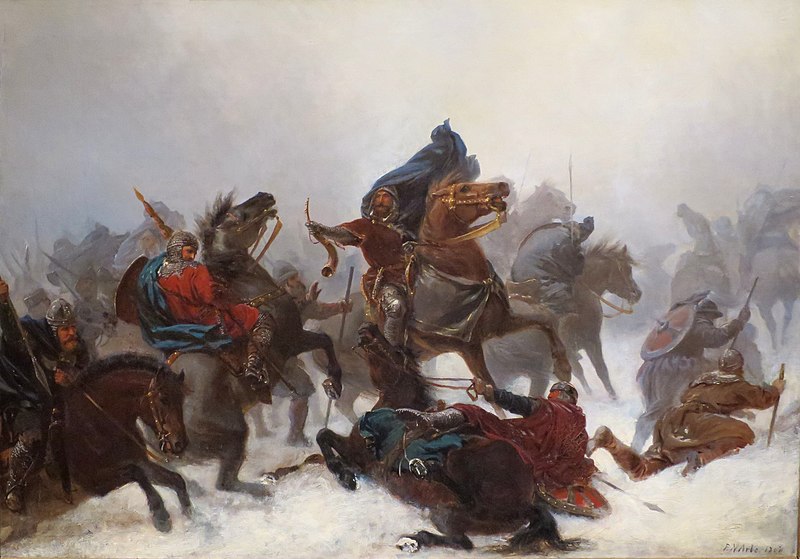
Sverre's trek across the Voss Mountains, by Peter Nicolai Arbo, c. 1800s

True Name: Sverrir Sigurðarson
Parents: Unås and Gunnhild
Date of Birth: c. 1145
House: Fairhair
Spouse: Margareta, daughter of Eric IX, king of Sweden, and Christina Björnsdotter
Reign: 1184 – 1202
Predecessor: Magnus V
Summary: Sverre grew up in the Faroes Islands far north of Scotland. He became a Catholic priest and received an excellent education in these early years. His mother revealed to him that he was the son of King Signurd Munn of Norway in 1175 (which was probably a lie) and Sverre set out for Norway to claim his throne. Norway, at the time, was recovering from a long civil war caused by successive claimants to the throne. Sverre went to Sweden to rally support from relatives of Sigurd's sister, Brigit. The group he joined was known as the Birkebeiners, and Sverre turned them into an army capable of conquering Norway. Sverre was crowned king at Øretinget in June 1177, and spent the next two years running west and east trying to take over Norway.


Magnus Erlingsson was the technical king of Norway at the time of Sverre's coronation, and Magnus was extremely angry that Norway was falling into civil war again as increasing number of factions joined Sverre's side of the conflict. The two rival kings fought on for five years, on land and sea, until Magnus fled to Denmark in 1183. Sverre them built a great ship to thwart his rival's inevitable return. At the Battle of Fimreite in 1184, Magnus's fleet was destroyed and the king drowned. Sverre was now the undisputed king of Norway. The king worked quickly to fill the political offices of Norway with his loyalists. Sverre, to legitimize any lingering doubts to his claim, married the daughter of the Swedish king. Still, with so many changes in so little time, civil war was inevitable. New factions arose in 1185 to challenge the king. Each faction presented their own royal descendant as their figurehead monarch, and each was put down by Sverre in turn, though not without much bloodshed. Then, in 1197, a new group arose and invaded Norway from Denmark. For the first time in recent history, Sverre was unable to defeat the pretenders. His capital city was besieged and the king was finally forced to flee. He rallied support in Trøndelag and was finally able to destroy the invaders, forcing them to flee back to Denmark in 1199. But peasants loyal to the invaders rose up the next year and the invaders returned with renewed strength and financing. Sverre spent his last two years fighting invasion from Denmark and uprisings from his peasants, eventually dying suddenly and leaving his son, Håkon, to finish his war for him.
Date of Death: 9 March 1202
Successor: Håkon III

Other Monarchs Who Died Today:
  • William I, emperor of Germany (1888)

Thursday, December 1, 2011

Two States, One King (Divided Rule)

Two years ago last December, I completed my master's dissertation on the topic of dynastic unions. Specifically, I focused on the dynastic union of England and the United Provinces of the Netherlands under King William III and the union of Great Britain (later the United Kingdom) and the Electorate of Brunswick-Lüneburg (later Kingdom of Hanover) under Kings George I-IV and William IV. It was a daunting task with a strong emphasis on ruling two states at the same time. Yet these individuals were only the last British monarchs in a long series of rulers to preside over multiple states simultaneously. Indeed, for a while it was vogue for monarchs to try and collect states, as it were, in order to expand their empire. Some they would fold into their own "mother" state while others would remain under outside control.


England's Bouts of Duality
Let's start this little survey with a look at what Britain has controlled off-and-on throughout its existence. I've already mentioned two so let's chalk them up:
William III, King of England
& Stadtholder of the Netherlands
  • The Kingdoms of England, Scotland & Ireland, et al. with The United Provinces of the Netherlands (1689 – 1702)
    • Ruler: King William III who was also Stadtholder of the Holland, Zeeland, Utrecht, Guelders & Overijssel (most of the Netherlands)
    • The Dutch Estates General ruled the Netherlands in his stead
    • The English Privy Council ruled Britain in his stead
    • How'd it start: William III conquered England (sort of) and deposed his father-in-law, thereby taking the crown. He was already stadtholder at the time.
    • Fate: Died leaving England in the hands of his sister-in-law Anne and Netherlands in the hands of nobody in particular
  • The Kingdom of Great Britain & Ireland, et al. with The Duchy of Brunswick-Lüneburg and Electorate of Brunswick (1714 – 1803, 1813 – 1832)
    • Rulers: Kings George I, George II, George III, George IV, and William IV who were also hereditary rulers of the region immediately around Hanover in Germany
    • The English Privy Council, the Queen, and/or the Prince of Wales ruled Britain in their stead
    • The Hanoverian Regency and/or the Prince of Wales ruled Hanover in their stead
    • Communication was via a special agency unaffiliated with the British government
    • How'd it start: To avoid another Catholic monarch, the British monarchy went to their 52nd choice in the line of succession: an elderly granddaughter of James I. She died and her German son inherited Britain.
    • The Kingdom of Great Britain & Ireland became the United Kingdom in 1801
    • The Duchy of Brunswick-Lüneburg became the Kingdom of Hanover in 1814
    • Fate: Separate succession laws left Britain in the hands of Queen Victoria and Hanover in the hands of King Ernest Augustus
    • Duchy of Brunswick-Lüneburg. Note: Bremen, Verden, Osnabrück, and
      Lauenburg were also all dynastic unions. Brunswick -Wolfenbüttel was
      a separate possession of a younger branch of the House of Este-Welf.
These are rather late additions, so let's step back into time and see what other dynastic unions existed. Two have already been implied though not mentioned:
  • The Kingdom of England with The Kingdom of Ireland (1542 – 1651, 1659 – 1801)
    • Rulers: All English monarchs from Henry VIII onwards until 1801
    • The Lord Lieutenant of Ireland ruled in their stead
    • How'd it start: The Kingdom of Ireland replaced the semi-sovereign and often autonomous Lordship of Ireland which was also presided over by the Lord Lieutenant. Ireland had been partially conquered by Normans in the 12th century and Henry VIII finished the job...mostly.
    • Fate: Ireland had little independence in the union and Great Britain and Ireland finally formed a constitutional union in 1801
The Royal Standard of the United Kingdom
(Note: First and Fourth quarters represent England, the
second represents Scotland, and the third Ireland.)
  • The Kingdoms of England & Ireland with The Kingdom of Scotland (1603 – 1651, 1660 – 1707)
    • Rulers: All English monarchs from James I onwards until 1707
    • The Scottish Parliament and Privy Council ruled in their stead
    • How'd it start: Elizabeth I died leaving three possible heirs: the most senior—the Scottish king—or one of two squabbling heiresses who broke the queen's rules. She went with the Scotsman.
    • Fate: Scotland attempted to end the union but failed and were forced to enter into a constitutional union in 1707
There are dozens of other unions England had with other states throughout its medieval history. Most of these territories were in France. While England very briefly claimed true control over the French throne in the 15th century, I will gloss over that to focus on two other historically more important territories that England once controlled:
Map of France in 1154. Normandy is the pink bit in
the north. Aquitaine is the large peach part in the
middle and south. Note: Brittany (orange on left)
and Anjou (center red) were also dynastic unions.
  • The Kingdom of England with The Duchy of Normandy (1066 – 1087, 1106 – 1144, 1150 – 1204 [– Present])
    • Rulers: William I, Henry I, Stephen, Henry II, Richard I and John
    • A regent and/or Lord Lieutenant ruled Normandy in their stead
    • How'd it start: William I of Normandy invaded England and killed his predecessor, Harold II, and deposed the upstart, Edgar II.
    • Fate: Conflict with France over sovereignty in Normandy resulted in the French confiscation of Normandy in 1204.
    • Today: The Channel Islands, primarily Guernsey and Jersey, remain Crown Dependencies under the name "Duchy of Normandy" and are the last remnant of the once-great duchy. These islands are not a part of the United Kingdom though are administered by it. The Lieutenant Governor of each set of islands rules in the monarch's stead.
  • The Kingdom of England with The Duchy of Aquitaine ([1152] 1204 – 1362)
    • Rulers: Technically, Eleanor of Aquitaine ruled until 1204, but her husband, Henry II, and sons, Richard I and John, both ruled in her stead many times. Henry III, Edward I, Edward II, and Edward III also ruled.
    • A Regent ruled in their stead.
    • How'd it start: Henry II married the Aquaitaine duchess, Eleanor, and took her lands for his own.
    • Fate: The French got fed up with England not respecting them, so reclaimed their fief. England countered by claiming the French crown. So began the Hundred Years' War. Neither side really could claim the title after that.
Finally, just as a fun aside, the British monarch is still technically in one last dynastic union (not counting the Commonwealth countries) with a tiny little island sitting in the Irish Sea:
The Kingdom of Mann was
once much larger and included
the Western Isles of Scotland
  • The Kingdom of England with The Lordship of Mann (1765 – Present)
    • Rulers: Every British monarch since George III
    • A Lieutenant Governor rules in their stead
    • How'd it start: In 1399, Henry IV conquered the Kingdom of Mann from its hereditary ruler. It had previously alternated between Norwegian, Scottish, and English control for centuries. It fell into the Stanley family and, in 1504, they renounced the title "King" in favor of "Lord". In 1765, the Baroness Strange sold the title back to the English crown.
    • Fate: Today, the monarch of the United Kingdom is also, separately, the Lord of Mann. It is administered separately as with the Channel Islands (see Duchy of Normandy).

More Problems than an Oversized Chin
The Habsburgs of Austria had their own divided monarchy that, at times, remained divided for long periods of time, but every once in a while, they would recombined to become truly behemoth political entities that would span the breath of Europe. Three long-term unions and one amazingly brief union created a Habsburg empire that still boggles modern minds.
  • The Archduchy of Austria with The Kingdoms of Bohemia & Hungary (1438 – 1918)
    • Rulers: Various Habsburg monarchs until 1918
    • The Habsburg monarchs ruled Bohemia through various means, but rarely directly
    • How'd it start: Albert married the daughter of the previous king of both Bohemia and Hungary. He was crowned king of Hungary in 1438 and Bohemia six months later, but never ruled in the latter. The Habsburgs did not firmly establish themselves in either until 1526.
    • Fate: Hungary remained a part of Austria-Hungary until 1918 and the monarchy was officially ended on 1921. Bohemia was incorporated into the Austrian Empire in 1806 and became crown land in 1867. It later became half of Czechoslovakia after World War I.
Map of the Ethnic Composition of Austria-Hungary in 1910. Note: Only Austria, Hungary and Bohemia were legal
dynastic unions. Bosnia, Croatia, Dalmatia, Transylvania, Galicia, and Moravia were all artificial monarchies.
Map of the Iberian Peninsula, 1570. Note: Galicia (top left),
Aragon (top right), and Cordoba (bottom center) were all
in dynastic unions with Castile (Spain) during this period.
  • The Kingdom of Spain with The Kingdom of Portugal (1560 – 1640)
    • Rulers: Philip II of Spain, Philip III and Philip IV
    • A Viceroy of Portugal ruled in their stead
    • How'd it start: The last obvious heir to the Portuguese throne died leaving it vacant with the Spanish monarch, Philip II, in a prime dynastic, political, and military position to claim it.
    • Fate: Fed up with Spanish domination of politics and an obvious loss of their overseas empire, Portuguese revolutionaries deposed Philip IV and installed a native king.
A Map of the Burgundian Inheritance. The lands
dynastically unified to Spain in the Low Countries
were vast and spanned seven modern countries.
  • The Kingdom of Spain with The Duchy of Burgundy (1516 – 1555)
    • Ruler: Charles I of Spain, also known as Holy Roman Emperor Charles V
    • Many different methods were used to rule his empire
    • How'd it start: First off, this dynastic union appears very mediocre for all the hype, so let's explain. The Kingdom of Spain at this time did not just include what we think of today as Spain. It also included all of Italy south of Rome and Sicily. He inherited all of this from his mom, though technically she was still alive until 1555. Next, Burgundy refers to a large area that today includes Belgium, Netherlands, Luxembourg and parts of Germany and France. It was on par in side to Portugal but with much more valuable land. He inherited this lot from his dad, Philip the Handsome, in 1506. In addition, Charles was also an Archduke of Austria, was elected Holy Roman Emperor (which technically means he was King of Italy and Germany), and he also ruled over all the new Spanish possessions overseas. So in literal size, his empire was quite large for a European monarch.
    • Fate: Inevitably, he tired of ruling such a large empire. He actually abdicated two years before his death. Spain, Italy, and Burgundy he left to his son, Philip II. The Holy Roman Empire he left to his brother, Ferdinand I.

Danes Among Us
Denmark has led a long history of dual monarchy. Stationed on the small peninsula that divides the North Sea from the Baltic Sea, it is in prime position to claim both the fjords of Norway and Sweden and the flats of Germany. And claim them it did, though not without significant resistance. Two long dynastic unions proved that a small country could still play it large.
  • The Kingdom of Denmark with The Kingdoms of Sweden & Norway (1397 – 1523)
    • Rulers: Margaret, Erik, Christopher III, Christian I, John and Christian II
    • Sweden and Norway maintained regencies in their stead (and sometimes against them)
    • How'd it start: Queen Margaret I of Denmark married King Haakon VI of Norway and their son, Olaf III, became king of both in 1380. In 1389, Margaret united Sweden to Denmark and in 1396, Erik of Pomerania was elected the first king of all three realms. The union was formalized the next year via the Treaty of Kalmar.
    • Fate: Almost immediately, the Swedes came into conflict with the Danes over Danish wars in northern Germany. Sweden elected an anti-king, Charles VIII, who was deposed and restored numerous times. Eventually Sweden would elect Gustav Vasa as king and secede from the union permanently, only to become involved in their own German wars.
The Kalmar Union. Note: Lower Finland was a dependency of Sweden while
Greenland, Iceland, the Faroe Islands, the Shetland Islands, and the Orkneys
were dependencies of Norway. Schleswig-Holstein in Germany was in a
dynastic union with Denmark throughout this time.
  • The Kingdom of Denmark with The Kingdom of Norway (1536 – 1816)
    • Rulers: All kings of Denmark until 1816
    • Norway maintained a regency in their stead
    • How'd it start: With the fall of the Kalmar Union (see above), Denmark retained Norway, though not without a fight. Denmark's dynastic claim over Norway was stronger, and Norway was unable to resist Danish domination to the same degree as Sweden.
    • Fate: Norway was traded to Sweden following the Napoleonic Wars and, after a brief war between Norway and Sweden, the two countries entered into their own dynastic union that lasted until 1905, when Norway finally became an sovereign kingdom once more.

Poling your Weight Around
Poland, too, was the senior partner in a long dynastic union. While Poland jumped in and out of other unions throughout its history, it's union with one partner withstood the test of time.
The Polish-Lithuanian Commonwealth, 1618. The sheer size of this dynastic
union is unbelievable. Livonia (gray), Courland (greenish), and Prussia (peach)
were vassal states of Poland-Lithuania but not in dynastic union with it.
  • The Kingdom of Poland with The Grand Duchy of Lithuania (1382 – 1795)
    • Rulers: All kings of Poland until the dissolution of the monarchy in 1795
    • It is unknown how these monarchs ruled both realms
    • How'd it start: Grand Duke Ladislas II of Lithuania married "King" Hedwig of Poland. When she died, Ladislas became ruler of both. 
    • Fate: Sigismund II constitutionally unified the two lands in 1572, though both retained autonomy. The monarchy became elective after that date, though it stayed in the Vasa family of Sweden for many generations. The entire monarchy fell apart in the French Revolutionary Wars and its fractions were given to Russia, Prussia and Austria.

Conclusion
Almost every monarchic state in Europe at one time or another controlled another state. France was often the largest player, but its attachments were almost always geographically close to France and also geographically smaller. Spain ruled vast lands around the Mediterranean for many years, including much of southern Italy. Sweden and Denmark both had their hands on significant lands in Northern Germany for awhile. In the end, most dynastic unions have to come to an end. The junior partner either joins the senior partner in a constitutional union or the two separate permanently. Today, quasi-states such as Mann and the Channel Islands are exceptions rather than the rule.

Attempts to force dynastic unions, such as that of the Austrian Netherlands (Belgium) and United Provinces (Netherlands) after the Napoleonic Wars, generally fail. The Prussian and Sardinian technique of blatant conquest and monarchic overthrow, such as in the unifications of Germany and Italy, seem to work better. The other technique, largely used by France and Spain, of slowly marrying into title-holding families and inheriting the titles also works better.

Nonetheless, throughout history most monarchies have experienced periods of dynastic union and it is an interesting, albeit often overlooked, aspect of nation-building that I find absolutely riveting.

Friday, September 17, 2010

What's So Old About an Oldenburg? (Oldenburg, Part 1)

House of Oldenburg Coat of Arms

 I have spent considerable time discussing extinct and dissolved dynasties but have not yet completed my survey of extant dynasties. There are primarily two remaining for Europe, and a few smaller singular ones as well. However, no other has been able to maintain such an expansionist vision as the House of Oldenburg.
The Kalmar Union

The Kalmar Union was in crisis in 1448. The precarious union of Denmark, Sweden, and Norway had never been strong and certainly was wavering when the former king, Christopher of Bavaria, died. His widow, the Dowager Queen Dorothea of Brandenburg, needed to keep the union together and the Danish courts turned to a distant descendant of a bygone king, Count Christian of Oldenburg, to reunify the three states. Sweden and Norway were caught unawares. Sweden elected its own king, Charles VIII, instead of returning to the union, while Norway was fought over by the two rivals. Norway first went to Sweden, but quickly an agreement was made that attached it to Denmark in perpetuity. At the same time, Christian I married Dorothea, solidifying his claim to the Danish throne. Political catastrophe befell Charles VIII and the Kalmar Union was reestablished under the rule of Christian I and the the House of Oldenburg. In 1460, Christian I added to his Oldenburg lands the duchy of Schleswig, in Denmark, and country of Holstein, in the Holy Roman Empire. Holstein was elevated to a duchy soon after, allowing Christian I to play in the realm of German politics.

Oldenburg power in Sweden declined steadily over the next 100 years until Christian II, in 1520, massacred 100 anti-Union protesters in the Stockhold Bloodbath. The subsequent withdrawl by Sweden from the Kalmar Union the next year was no surprise and the House of Vasa took power there for the next century or so. Norway suffered from the dissolution, and in 1536 was permanently made into a Danish province, with all its hereditary lands such as Greenland and Iceland being transferred to Danish control (Greenland remains a Danish possession today). Denmark then jumped headlong into the Reformation, with Frederick I declaring Denmark-Norway to be a Lutheran country in 1526. However, religious tolerance toward Catholics caused internal strife and external war. When Frederick I died, the Catholic members of the Danish courts refused to acknowledge Frederick's son, Christian III, as king. The Catholics raised up Count Christopher of Oldenburg, a distant cousin of Christian's, as a possible regent for Christian III, while other Catholics tried to return Christian II, who had been deposed in 1523, to the throne. All of it was for naught, though. Despite a thorough ravaging across his lands, Christian III survived it all, defeated all his enemies, and reestablished Danish control. Denmark has been Lutheran ever since.
Christian IV, King of Denmark
Denmark was now a power to be reckoned with. After watching the progress of the Thirty Years War, in 1625 King Christian IV built up an army and set out for Catholic possessions in Germany. Unfortunately, his allies were weak and distracted, unwilling to give him more than lip-service aid. The Catholic army of Emperor Ferdinand II, on the other hand, was strong and had the element of surprise, since Christian IV didn't know it existed. After many failures and the conquest of half of Denmark, Christian IV negotiated a treaty that removed Denmark from German politics in perpetuity. More failures in the Torstenson War against the Netherlands and Sweden resulted in the loss of duties from ships passing through Danish waters in the Baltic Sea. Sweden took control of a large chunk of southern Norway and the Dutch no longer had to pay transport taxes to trade with Sweden. When Christian died, Frederick III decided to get revenge on Sweden. The Second Northern War, as it was called, was yet another Danish failure. Denmark was ravaged by Sweden and the Swedes were even able to invade Copenhagen, with the ice connecting it to the mainland frozen over in a rare cold spell. Charles X of Sweden wished to remove Denmark from existance but Copenhagen held fast against the Swedish army, especially once Dutch help finally came. When Prussia, Poland, and Austria all joined the side of Denmark, Sweden finally capitulated. In the Treaty of Copenhagen, borders were agreed upon and the territorial borders of Denmark and Sweden have remained the same ever since.

Frederick III and his successors entered into the age of absolutism as monarchs with a cause but no power to do anything about it. Twice they tried to go to war with Sweden again in hopes of reclaiming lost lands, and twice they failed to do so. Over the course of the 18th century, Denmark centralized around Copenhagen even while the Danish nobles stole power from the king. This all ended in 1807. The Napoleonic Wars had forced most of Europe to take sides, but Denmark was resolute on remaining neutral. Nonetheless, Britain feared that France would invade Denmark and take their ships, so Britain captured the majority of the Danish navy and added it into their own. Denmark stayed out of the war until it joined with France against the Sixth Coalition. It won some victories but lost the war and, in 1814, was forced to cede Norway to Sweden despite strong Norweigan resistance.

Kingdom of Denmark-Norway
The age of revolutions followed and on June 5, 1849, Denmark became a constitutional monarchy. King Frederick VII was forced to cede some power to the courts although he still retained significant executive power. Meanwhile, the problem of what to do with the Duchies of Schleswig-Holstein, which was majority German, came to the forefront. Two wars took place from 1849 until 1864 to determine its rightful place in the Danish government. In the end, Prussia won out and annexed both duchies to Brandenburg-Prussia. Denmark had to reinvent itself after this, and in 1901, King Christian IX finally allowed the population to run itself by permitting the majority in parliament to run the government. Prior to this time, the nobles still controlled govenrment regardless of parliamentary majorities.
Queen Margarethe II of Denmark
King Christian X was the last king to truly use his executive power when he dismissed the government in 1920. This sparked an event known as the Easter Crisis, after which the king promised to not interfere in politics again, despite the constitution permitting royal interference. In 1918, Iceland became an independent country in personal union with Denmark, with Christian X remaining king of both. However, after Iceland's conquest by Britain during World War II, the union dissolved in 1944 with Iceland becoming a republic. Queen Margarethe II has been the ruler of Denmark since 1972 and when she dies, the House of Oldenburg will at last be at an end in Denmark, being replaced with the House of Laborde de Monpezat.

In Norway, despite Sweden's annexation of the state in 1814, the House of Oldenburg returned in 1905. Political unrest against the Swedes ended with Sweden renouncing their overlordship over Norway and Norway becoming an independent kingdom. The government rejected a republican government and instead elected Prince Charles of Denmark, second son of King Frederick VIII Denmark, as their new king. Charles took on the regnal name Haakon VII and led his country through a harsh neutrality during World War I. He attempted the same during World War II but was forced to flee in 1940 to London, where he set up his wartime headquarters to retake Norway.
Harald V, King of Norway
Since the war, the kings of Norway have been held in the highest esteem and are quite possibly the most highly favored monarchs in Europe. Both Haakon VII and his son, Olav V, had massive funeral ceremonies fully funded by the people with overwhelming public support. The current king, Harald V, is popular in both Norway and the United Kingdom, where he spent much of his youth. His powers are much weaker than those of his predecessors but he still retains some say in the Norwegian government.

Labels

[brief] (102) female monarch (31) Capet (26) [abbreviated] (19) Roman Empire (17) Great monarchs (16) Japan (15) Papacy (15) England (13) saints (13) France (11) Portugal (11) [Missing Deaths] (11) Habsburg (10) Sweden (10) Byzantine Empire (9) Carolingian (9) China (9) Hohenzollern (9) Oldenburg (9) Holy Roman Empire (8) Japan (dynasty) (8) Aragón (7) Austria (7) Denmark (7) Electorate (7) Ethiopia (7) Hungary (7) Navarre (7) Norway (7) Romanov (7) Russia (7) Saxony (7) Scotland (7) Wettin (7) Wittelsbach (7) Bavaria (6) Burgundy (6) Egypt (6) Italy (6) Lorraine (6) Luxembourg (6) Persia (6) Poland (6) Sicily (6) Spain (6) Valois (6) Capet-Burgundy (5) Franks (5) Germany (5) Plantagenet (5) Prussia (5) Quraish (5) Solomon (Ethiopia) (5) Tuscany (5) Anjou (4) Aquitaine (4) Barcelona (dynasty) (4) Bohemia (4) Brittany (4) Burgundy-Aviz (4) Burma (4) Capet-Valois (4) Castile (4) Constantinople (Patriarchate) (4) Habsburg-Lorraine (4) Holstein-Gottorp-Romanov (4) India (4) Ireland (4) Jerusalem (4) Jiménez (4) Kiev (4) Mongolia (4) Naples (4) Netherlands (4) Normandy (4) Osman (4) Ottoman (4) Palaeologos (4) Savoy (4) Savoy (dynasty) (4) Trastámara (4) Wales (4) Afghanistan (3) Albania (3) Bagrationi (3) Banu Hashim (3) Blois (3) Borjigin (3) Bourbon (3) Brabant-Hesse (3) Brandenburg (3) Capet-Bourbon (3) Cologne (3) Croatia (3) Cyprus (3) Disney (3) Fairhair (3) Georgia (3) Gwynedd (3) Hainaut (3) Hesse (3) Hohenstaufen (3) Holland (3) Holstein-Gottorp (3) Inca (3) Islam (3) León (3) Limburg (3) Lithuania (3) Livonia (3) Lothier (3) Macedonia (dynasty) (3) Mainz (3) Mann (3) Medici (3) Morocco (3) México (3) Nassau (3) Nguyễn (3) Serbia (3) Stuart (Stewart) (3) Toungoo (3) Tudor (3) Turkey (3) Vaudemont (3) Vietnam (3) Welf (3) Wessex (3) published articles (3) Abberfraw (2) Aberffraw (2) Alexandria (patriarchate) (2) Angevins (2) Anglo-Saxon (2) Ardennes-Metz (2) Auvergne (2) Ayyubid (2) Basarab (2) Bernadotte (2) Billung (2) Boulogne (2) Brabant (2) Bruce (2) Burgundy-Bragança (2) Caliphate (2) Cilicia (2) Constantine (2) Crovan (2) Denmark (Dynasty) (2) Draculesti (2) Dreux (2) Dunkeld (2) Dutch Republic (2) Estridsen (2) Flanders (2) Florence (2) Further Austria (2) Greece (2) Habsburg-Spain (2) Hanover (2) Hardrada (2) Hauteville (2) Hawai'i (2) Ivrea (2) Joseon (2) Karadordevic (2) Konbaung (2) Korea (2) Maya (2) Merovingian (2) Milan (2) Ming (2) Monaco (2) Nassau-Orange (2) Nassau-Weilburg (2) Norman (2) Novgorod (2) Orange (2) Ottonian (2) Piast (2) Piedmont-Savoy (2) Poitiers (dynasty) (2) Robertian (2) Romania (2) Rurik (2) Sardinia (2) Saxe-Coburg-Gotha (2) Seljuk (2) Siam (2) Syria (2) Teutonic Knights (2) Thailand (2) Theodosian (2) Thuringia (2) Timurid (2) Tokugawa (2) United Kingdom (2) Valois-Burgundy (2) Vandal (2) Venice (2) Visconti (2) Vladimir (2) Wallachia (2) Württemberg (2) York (2) Yugoslavia (2) Zeeland (2) the Britons (2) 18th Dynasty (Egypt) (1) Abbasid (1) Adal (1) Agiad (1) Akinyele (1) Al Khalifa (1) Al-Said (1) Alawiyya (Egyptian) (1) Albret (1) Algeria (1) Algonquian (1) Amber (1) Angola (1) Anjou (dynasty) (1) Anjou-Hungary (1) Ansbach (1) Antonia (1) Antonine (1) Apulia (1) Arabia (1) Armenia (1) Arpad (1) Arsacid (1) Asen (1) Ashikaga (1) Athens (1) Avesnes (1) Avignon Papacy (1) Aviz-Beja (1) Aztec Empire (1) Baden (1) Bahrain (1) Balti (1) Barakzai (1) Barazkai (1) Barcelona (1) Battenberg (1) Belgium (1) Bengal (1) Berg (1) Berg (dynasty) (1) Bernicia (1) Bharatpur (1) Bhutan (1) Bjelbo (1) Bonaparte (1) Bonde (1) Bonngau (dynasty) (1) Borghese (1) Borja (1) Bosnia (1) Bourbon-Two Sicilies (1) Brandenburg-Ansbach (1) Brienne (1) Brutus (1) Bukhara (1) Bulgaria (1) Canossa (1) Capet-Dreux (1) Carthage (1) Celje (1) Celje (dynasty) (1) Chakri (1) Champagne (1) Champagne (dynasty) (1) Chartres (1) Cometopuli (1) Contantine (1) Cordoba (1) Craiovesti (1) Crusader States (1) Dalmatia (1) Damascus (1) Danesti (1) Debeubarth (1) Deira (1) Deira (dynasty) (1) Denmar (1) Dulo (1) Díaz (1) Early Han (1) East Anglia (1) East Francia (1) Eastern Han (1) Eastern Jin (1) Egmont (1) Estonia (1) Farnese (1) Fatimid (1) Fatimid Caliphate (1) Flanders (dynasty) (1) Flavian (1) Friuli (1) Gausi (1) Geneva (1) Geneva (dynasty) (1) Gordiani (1) Grimaldi (1) Guelders (1) Guideschi (1) Gwent (1) Gwynedd (dynasty) (1) Gyatso (1) Haag (1) Hainaut (dynasty) (1) Hanan Cuzco (1) Hashim (1) Hashimite (1) Hebrides (The Isles) (1) Hellenes (1) Herat (1) Hohenzollern-Ansbach (1) Hohenzollern-Sigmaringen (1) Holland (dynasty) (1) Hunfriding (1) Ibadan (1) Iran (1) Iturbide (1) Jaipur (1) Jin (1) Jordan (1) Julio-Claudian (1) Jungingen (1) Justinian (dynasty) (1) Kachwaha (1) Kalakaua (1) Kamehameha (1) Karrani (1) Kent (1) Kent (house) (1) Kestutis (1) Khurasan (1) Knights Templar (1) Komnenos (1) Kotromanić (1) Lakota Sioux (1) Lancaster (1) Latin Empire (1) Lebanon (1) Leuchtenberg (1) Lombards (1) Ludowinger (1) Lusignan (1) Luxembourg (dynasty) (1) Luxembourg-Limburg (1) Maan (1) Macedon (1) Magdeburg (1) Maine (1) Majorca (1) Malaysia (1) Manghit (1) Maratha Empire (1) Marinid (1) Matsunaga (1) Maurya (1) Mecklenburg (1) Mecklenburg-Strelitz (1) Meissen (1) Mercia (1) Mercia (dynasty) (1) Miniconjou (1) Moldavia (1) Montenegro (1) Montferrat (1) Morgannwg (1) Mortain (1) Mountbatten (1) Mughal (1) Muhammad Ali (1) Munster (1) Musat (1) Myanmar (1) Nakagawa (1) Ndongo and Matana (1) Nemanjic (1) Nepal (1) Nervo-Trajan (1) Neuchâtel (1) Nigeria (1) Nominoë (1) Northumbria (1) O'Brien (1) Obrenović (1) Odowa (1) Olgovich (1) Olympus (1) Orléans-Longueville (1) Ostrogoths (1) Ottawa (1) Pahlavi (1) Palatinate of the Rhine (1) Parma (1) Penthièvre (1) Petrović-Njegoš (1) Poděbrady (1) Pointiers (Ramnulfids) (1) Poitiers (1) Poitiers-Lusignan (1) Polignac (1) Powys (1) Prasat Thong (1) Premyslid (1) Provence (1) Přemyslid (1) Q'umarkaj (1) Qin (1) Qing (Manchu) (1) Reginar (1) Reginarid (1) Rethel (1) Rethel-Boulogne (1) Ribagorza (1) Rouergue (1) Roupenians (1) Sa Malietoa (1) Safavid (1) Salian (1) Salzburg (1) Samoa (1) Sarantapechos (1) Saud (1) Saudi Arabia (1) Second Triumvirate of Rome (1) Selangor (1) Selangor (dynasty) (1) Sforza (1) Shah (Nepal) (1) Shi'a Imamate (1) Shishman (1) Shivaji (1) Silesia (1) Simmern (1) Sinsinwar Jat (1) Skowronski (1) Slovenia (1) Sobieski (1) South Africa (1) South America (1) Sparta (1) Spoleto (1) Sture (1) Sudan (1) Sussex (1) Sverre (1) Swabia (1) Swasi (dynasty) (1) Swaziland (1) Swiss Confederation (1) Tang (1) Tenochtitlan (1) Teotihuacán (1) Terter (1) Tibet (1) Tikal (1) Tolkien (1) Toulouse (1) Tours (dynasty) (1) Transylvania (1) Tunisia (1) Umayyad (1) Unruoching (1) Valencia (1) Valois-Angoulême (1) Valois-Anjou (1) Valois-Orléans (1) Vasa (1) Vermandois (1) Visigoths (1) Vokil (1) Wangchuck (1) Wied-Neuwied (1) Windsor-Mountbatten (1) Württemberg (dynasty) (1) Yamato (1) Ying (Qin) (1) Yuan (1) Zanzibar (1) Zhao (Song) (1) Zhou (1) Zhu (1) Zogu (1) Zulu Nation (1) Zápolya (1) Zähringen (1) bretwalda (1) cardinal (1) fantasy (1) fiction (1) shogunate (1) terms (1) Árpád (1) Öuchi (1)