Tuesday, April 11, 2017

Meandering Adventures of Cognatic Inheritance

There are numerous ways in which titles can be passed, but primogeniture, where the eldest child inherits all of the titles, is one of the most well-recognised inheritance systems in the West. But this system has a problem: which child is considered the oldest? Is it the first-born, male or female (absolute primogeniture)? Is it the eldest male (agnatic primogeniture)? Or is it the eldest male, or the eldest female if there is no male (cognatic primogeniture)? In different countries, there are different rules, and these are but three of them.

For the sake of this discussion, let us just focus on one: cognatic primogeniture. Cognatic succession can be anathema to a dynasty. If a dynasty is patrilineal, then cognatic succession can allow a title—or all the tiles—to separate from that patrilineal line. Thus, cognatic titles can appear over generations as wayward travellers, traversing several dynasties in only a few generations. Such problems rarely impact agnatic succession systems, or seniority, or elective monarchies because all of those systems favour men more absolutely. But cognatic succession systems, even if they favour elder male children over female children, inevitably will revert the succession to a female line (a cognate).

There are numerous polities throughout Western European history that have allowed women to succeed, and sometimes those titles pass through numerous female holders. Generally—although not always—a female title holder will share her titles with her husband so long as she is alive, at which point the titles pass to her eldest child or to her nearest relative. Thus, just because a system allows female transmission of titles does not mean she gains exclusive use of those titles. Some women certainly insist upon exclusive regnal prerogatives, but not all of them. In other words, men still often become counts or kings when their wives hold the rights. Legally, this practice is called suo uxoris (by right of wife) and suo uxoris titles rarely outlast the woman from whom the titles derive.

There are a number of important cases of monarchies which were ruled, and indeed dictated, by the precepts of cognatic succession. Some of the most famous—England, Denmark, Russia, and Spain—rarely actually operated off of cognatic succession or, when they did, they often skipped women in favour of eldest sons. But a few polities, specifically many in France, experienced multiple female rulers throughout their existences.

The Lost Kingdom of Spain
Perhaps the most notorious European kingdom to experience the potential upheavals of cognatic succession was the Pyrenean kingdom of Navarre. Established in the mid-ninth century as one of two crusader states that began the expulsion of the Moors from Spain, Navarre's dalliance with cognatic succession did not begin until the Jiménez line of kings went extinct in 1234. Because of its Basque origins, Navarre had accepted the tenets of cognatic succession even if it never used such laws. The crown passed to a French lord, Thibaut IV, count of Champagne, whose mother had been the sister of the last Jiménez king, Sancho VII. For the next 80 years, the Champagnois ruled Navarre.

The kings and queens of Navarre, 1150 – 1643
Jeanne I, queen of Navarre and countess
of Champagne and Brie
In 1274, the last Champengois ruler, Jeanne I, married the future Philippe IV of France, thereby unifying Navarre with the French crown for the next 54 years. Philippe adopted the title of king at the time of his marriage, and their son Louis became the next king of Navarre in 1305 when Jeanne died. His brothers, Philippe and Charles, and then his daughter, Jeanne II, all held the royal title during their lifetime. But with Jeanne, the title once again was held alongside her husband, Philippe III. When she died in 1349, her son, Charles II, and then grandson, Charles III, followed her on the throne.

Yet another upheaval came in 1425 when Charles III's daughter, Zuria I, succeeded him. Her husband, Juan II (future king of Aragón) seized the royal title more decisively than was usual and when she died in 1441, he kept the royal title against her will, depriving his son and eldest daughter their due rights. Their younger daughter, Leonor, succeeded briefly in 1479 only after he had died. Her grandson, François Phoebus, reigned for four years after her death, and then her daughter, Catherine, became the next queen, ruling alongside her husband, Jean III d'Albret. During their reign, most of the kingdom was conquered by Aragón, leaving only a small portion on the northern side of the Pyrenees for them to rule.

Jeanne III d'Albret, queen of Navarre and
countess of Foix
Catherine died in 1517 leaving the crown to her son, Henri II. He, in turn, left yet another daughter, Jeanne III, as his heir. Jeanne took the throne in 1555 alongside her husband, Antoine de Vendôme, who ruled briefly until 1562. When Jeanne died in 1572, their son, Henri III, succeeded and began the ultimate end of Navarrese independence. Shortly after succeeding, he became the heir to the French throne through their laws of strict agnatic primogeniture. He became king of France as Henri IV in 1589, unifying for a second time the French and Navarrese crowns. But this time, it became permanent. His son, Louis XIII of France, permanently ended Navarre's independence in 1620, permanently unifying the kingdom to France. Thus, when the titular Louis XVII died in a French revolutionary prison in 1795, the claim to Navarre did not pass to his sister, but rather to his uncle, Louis XVIII, and subsequent French kings. France and Navarre, united twice, became bound together permanently due to cognatic succession.

The Itinerant French County
The case of cognatic succession can get just as extreme, if not more so, when impacting a county. The tiny county of Boulogne on the French side of the English Channel is one such case. Originally granted to Baudouin II of Flanders as a fief, it passed through a series of men until the line came to an end with Mathilde I in 1125. Mathilde was married to none other than Stephen of Blois, the future king of England. Stephen never became count of Blois, but he did assert his wife's titles from 1125 until 1151, when Mathilde died. At this point, the title passed to two of his sons in succession before falling to his eldest surviving daughter, Marie I. Like Mathilde, Marie ruled alongside her husband Mathieu of Alsace, but their marriage was not amicable. In 1170, they divorced, but Mathieu continued to claim the comital title until his death in 1173 (she lived until 1182). While this practice was unusual, it was not unheard of and paralleled the usurpation of Juan II of Aragón, above.

The rulers of Boulogne and later rulers of Auvergne, 1087 – 1653
Mathieu and Marie had a daughter, Ida, who became one of the most highly desirable heiresses in northern France. She married four times and each of her four husbands took her titles as his own. Her final marriage to Renaud, count of Aumâle, was forced upon her by the king against her wishes. Her husband proved a recalcitrant vassal, too, and fought against Philippe II Auguste of France until he was ultimately imprisoned. Ida's daughter by Renaud, Mathilde II, succeeded her in 1216 and was almost immediately betrothed to Philippe Hurepel, Philippe's son of questionable legitimacy. Suddenly, the Capetian family had taken hold of Boulogne through cognatic marriage.

Jeanne II, duchess of Berry and countess of Boulogne
Philippe Hurepel, though, did not live more than a decade and in 1235, Mathilde married the future king of Portugal, Afonso [III]. But both marriages proved childless and the succession passed to her nearest senior heir, who happened to be another woman: Adelaide, wife of Guillaume III of Auvergne. For the next four generations, Boulogne and Auvergne would be linked together via a succession of male rulers. However, both titles were transmittable via cognatic primogeniture and eventually fell to Jeanne I, who married in 1338 Philippe, son of the duke of Burgundy. She later married, after his death, King Jean II of France, once again binding the fate of Boulogne to that of the Capetians. But the county escaped outright annexation through sheer dynastic bad luck when her son, Philippe, died young in 1461. Her titles then passed to her paternal uncle, Jean II. Jean's granddaughter, Jeanne II, almost dragged the dynasty into the Capetian fold for a third time since she was married to Jean, duke of Berry, an uncle of King Charles VI. Indeed, the county was elevated to a duchy at this time (although the duchy was, oddly, separate from the county). But their childlessness allowed the titles to be transmitted to yet another female relative, Marie II, whose husband had already died by the time she succeeded to Boulogne and Auvergne.

Catherine de' Medici, queen of France
and countess of Auvergne
For the first time in Boulogne's history, there was a female regnant countess not beholden to her husband's whims or the demand that she be married again after being widowed. Marie lived until 1437, at which point her male progeny succeeded her, members of the House of La Tour. The county of Boulogne was annexed to the royal domain in 1501 after the last male of the line died, but the county of Auvergne passed to his daughter, Anne, whose husband was so preoccupied with Scottish affairs that she, too, had virtually full control over her ancestral county. When she died in 1524, the Auvergne title passed to her niece, Catherine de' Medici, who became queen of France through her marriage with Henri II and served as regent for her three sons, who reigned in succession, the last of the Valois kings of France. Auvergne became an embattled title from this point forward. The title was claimed by her son-in-law, Charles III, duke of Lorraine, until 1608, when it was seized by Catherine's daughter Marguerite, who had been married to Henri IV of France until they divorced in 1599. When Louis XIII of France became king in 1610, his government seized the Auvergne title claiming next-of-kin, although there were others who had a better claim. Concurrently in 1589, the Auvergne lands (but not titles) went to Charles, the illegitimate son of King Charles IX, who claimed them invariably until his death in 1650, after which his son, Louis-Emanuel claimed them for a few more years. At his death, the lands were seized by Louis XIII. The long history of cognatic descent in Boulogne and Auvergne saw it pass through numerous major and minor noble houses before it ultimately was appended to the many claims of the House of Bourbon, just as Navarre had been annexed slightly earlier.

Cognatic succession, therefore, can work in opposition to the generally clean successions provided by male-dominated modes. While from a gender standpoint it should make no difference whether a title passes to a son or a daughter, the geo-political situation in Western Europe until recently meant that most titles were held and descended through male lines to stop rogue cognatic titles such as Navarre and Boulogne-Auvergne from causing trouble. Their capacity to briefly attach themselves to others' titles meant that polities allowing cognatic succession such as these proved difficult to permanently attach to any one dynasty for more than a few generations.

Thursday, March 9, 2017

The Succession to Burgundy in 1461

The Burgundian state under
Philip the Bold, 1363 – 1404
In 1461, Philippe de Rouvres, the last duke of the senior line of the Capetian house of Burgundy, died leaving no obvious heir. He had no sisters, uncles, or aunts, although he did leave behind a wife, Marguerite III, countess of Flanders, Artois, Burgundy, Nevers, and Rethel. This came at a time of crisis in France. The Hundred Years War had only just paused the previous year and tensions were still high. Philippe, the young duke, was expected to live a long life and continue a dynasty that had existed since the eleventh century. Yet over the course of that century, almost every cadet line had ended after only a few generations, the most recent having ended in 1298.

In lieu of an obvious heir, the Burgundians had to figure out who should come next. There were two obvious candidates and an arguably more rightful, albeit overlooked option. The obvious choices were Carlos II, king of Navarre, and Jean II, king of France.

Carlos II the Bad, king of Navarre
Both Carlos and Jean were descended from sisters of Philippe's grandfather, Odo-Eudes IV. The elder sister was Marguerite, who married Louis X of France, had a daughter with him, the future Jeanne, and then promptly fell into ill-repute for sneaking off with a knight (the Tour de Nesle affair). She died under mysterious circumstances in 1315 while in a French prison, allowing her husband to remarry and promptly die shortly afterwards. That daughter, though, survived and became queen of Navarre in 1328. Carlos II, Jeanne's son and heir, bases his claim on her descent. Carlos, however, had become infamous in France as one of the most dangerous and recalcitrant vassals in French history. Due to his royal descent, he occasionally claimed the French throne, and he also stirred up all sorts of trouble in Paris between 1356 and 1360, when King Jean II was sitting comfortably in the Tower of London in England, a prisoner of Edward III. Although Carlos and Jean patched things up in 1360, they still were hardly friends. Nonetheless, Carlos could legitimately claim male-preference primogeniture as the reason for why he should become the next duke of Burgundy. The descent of his grandmother, as the eldest sister of Duke Robert II, should take precedent over a younger line.

Jean II the Good,
king of France
Jean II, however, was not about to allow the quarrelsome Navarrese king become the major power in both the south and east of France. Jean's mother was Jeanne the Lame, the younger daughter of Duke Robert II of Burgundy. This made him one degree closer to a previous duke. Jean was also the senior agnate of the entire Capetian dynasty and, as king of France, he was suzerain over Burgundy. Thus, he could use any or all of these excuses to claim Burgundian throne. Indeed, he won the debate, but he used his weakest argument to assert his claim. He argued that he was the head of the family and, as such, the title should revert to him since he was seniormost of the line. But there are two problems with this. First, Burgundy had never been a French apanage duchy. Indeed, Burgundy first joined the royal line through the merger of the former Burgundian royal line in the tenth century to a Capetian cadet branch. Therefore, women could inherit the throne and pass it on to their descendants through a process called substitution. The next agnate in line, then, was Carlos of Navarre. Following this same logic, Carlos also held the proximity of blood according to Roman and Burgundian law since he represented his deceased mother and grandmother. Jean may appear closer, but Carlos represents his grandmother, who was older than Jean's mother. Naturally, Carlos resisted Jean's encroachment on his rights, but to no effect. The recent treaties he had signed bound him to French authority and he essentially had no ability to adequately assert his case.

Pedro I the Just
king of Portugal
Second, while Jean may be the head agnate of the Capetian dynasty, there is still a single cadet branch of the Burgundian tree extant in 1361 and this line should get precedent over any of Jean's agnatic claims. Agnatic law says that when a male line goes extinct, one goes back in time along that line until another male line is found. In 1361, that line would have fallen squarely on Pedro I, king of Portugal, the agnatic heir to Philippe I of Burgundy. When Robert the Old, the first Capetian duke of Burgundy, died, his youngest grandson ventured into Castile, married a Castilian princess and was given the county of Portugal as a dowry. His son, Afonso, declared himself king of Portugal and fought a short war against León to assert his title. He and his legitimate descendants continued to rule Portugal until 1383, when Pedro's son Fernando I died leaving behind a daughter who was inconveniently married to the king of Castile. But in 1361, Pedro was still quite alive, making him the senior agnate of the Burgundian branch of the Capetian dynasty and the heir general to Philippe de Rouvres. Following Jean II's own logic, Pedro should become duke of Burgundy.

The obvious problem with this is that Pedro was in Portugal and was also, annoyingly, close allies with the English. There was no chance Pedro would be traveling to Burgundy anytime soon to claim his birthright. Instead, Jean seized the duchy and subsumed it within his royal title. When he died in 1364, his son, Charles V, granted it to his brother (following the will of his father), who became Philip the Bold, the first duke of the house of Capet-Valois-Burgundy. The duchy was now securely under dynastic control again. Philip married Marguerite III of Flanders in 1369 and received all her lands when her father died in 1384. Meanwhile, the legitimate Portuguese line went extinct in 1385, causing it to descend upon the illegitimate house of Aviz. The Iberian kings had lost their claim to Burgundy. Philippe could now rest assured that his claims were secure and his future bright. The rest is history.

Monday, March 31, 2014

The Piasts and Polish Succession Rules

Today begins a new phase of Dynastology articles based on my ever- expanding series of genealogies I have been creating...for no apparent purpose. What can I say: I'm devout! That being said, welcome to the confusing and problematic genealogy of the Piast Dynasty which ruled over Poland from at least 960 CE to 1370 CE, the majority of the Medieval Era. The Piasts faced Vikings invasions from Scandinavia, Magyar and Slav invasions from Hungary and Bohemia, and Mongol invasions from the Russias. In the end, though, it was the unique characteristics in their hereditary succession laws that allowed the dynasty to end its leadership of Poland.

First though, let's examine the primary ruling line:
For a high-resolution version in PDF, go here.
The early succession of the Piast line followed normal conventions of the time. It was nominally elective and somewhat agnatic in nature. To remind everyone, an agnatic succession law follows male-line descent when possible (Salic Law, an extreme, follows it until the male line is extinct). The early Piasts were all males—indeed, few females fit into the line and the Polish language never had a term for "queen regnant"—and the descent of the Piasts followed mostly normal succession laws of the time. The eldest member of the family generally succeeded to the throne while granting his male siblings subsidiary titles. Indeed, Poland's monarchy was dependent on the Holy Roman Empire until it became permanent with Władysław I. Three kings of Poland reigned during the first century of the country's existence, though none of them passed the title down to their successor.

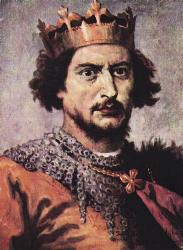
Bolesław II the Generous
Things went sour, though, when in 1138 Bolesław II died, dividing the lands between his five sons. He created a truly elective monarchy in which the only requirement seemed to be that the High Duke (the holder of the city of Krakow and the titular leader of the Poles) be a male-line member of the Piast Dynasty. This, at least, held until the elevation of the duchy to a kingdom. But such a vague succession system broke down almost immediately. Poland was fragmented for over 200 years with many parts never reuniting with the mother country. The sheer number of titles some members of the family bore during their reigns were ridiculous, with Konrad I of Oleśnica holding jointly the titles Duke of Namysłów, Ścinawa, Żagań, Poznań, Gniezno, Kalisz, Oleśnica, Koźle, and Bytom (many of these falling under the overarching title, Duke of Silesia).
During this time, the High Dukeship was to pass to the senior-most capable member of the family. But when the family is divided between literally a dozen or more branches of people, all technically in the same generation, such a system does not hold up. Scotland had a similar system known as tanistry, and it failed miserably with only three rival lines of descent. In Poland, the first to get the shaft was the Silesian line, which not surprisingly outlived all the others. The family was so expansive that it took three PDFs just to draw the entire family into the tree:

For a high-resolution version in PDF, go here.

For a high-resolution version in PDF, go here.
The Silesian Piasts suffered greatly during the time of Poland's division. Because of the succession practices of the day, the family was forced to divide and subdivide their individual properties until some were no larger than a town. A somewhat unusual system was also in place that allowed surviving wives of dukes to inherit, in both title and fact, one of her husband's former domains. Thus you have multiple instances of women that are not descended from the Piasts, often of noble German families, inheriting for their lifetimes duchies. Naturally, upon their deaths, these passed to their surviving sons or, lacking such heirs, to close male-line relatives of the deceased duke. Like the kingship itself, there was no title for a duchess regnant, but the term oprawa wdowia (widow's land) was used heavily to describe the situation.
Jerzy Wilhelm, Duke of Legnica
Over the decades and centuries, the Silesian Piasts were forced to cede and forfeit much of their land to Bohemia or the rulers of Bohemia, the House of Luxemburg (who were also Holy Roman Emperors much of this time). Indeed, the last member of the family to rule a portion of Silesia was not Jerzy Wilhelm, the duke of Legnica and Brzeg, but rather his mother, Louise, the duke of Oława and Wołow. Another interesting thing happened to the longest-surviving branch of the family, their frequent marriages into German nobility, specifically the Hohenzollern dynasty of Brandenburg, changed the very nature of their names. No longer were people named Władysław, Bolesław, Mieszko, and Kazimierz. Now they were named Jerzy (Georg), Jaochim Fryderyk (Joachim Friedrich), Jan Chyrstian (Johann Christian), Ludwig (Ludwig), Henryk (Henry), and Wilhelm. These were German names, ones very frequent especially in the Hohenzollern family. The rulers spoke German as much as married Germans, and their lands were considered just as much German as Polish. It came as no surprise that Austria and Bavaria both fought to take over Silesia in later wars with Poland. The lands were, to a large extent, German through multiple generations of intermarriage.

Back to the royal lines, though. With the Silesian Piasts mostly out of the picture (they claimed the High Dukedom a few times, but never for long), the other branches of the family were able to consolidate power. The two rival lines that fought over the tiles ruled, among other things, Greater Poland and Masovia respectively. The Greater Poland branch succeeded in having three High Dukes, with the last, Przemysł II, securing the kingship for himself. Unfortunately for him, not only did he not have any heirs, but he also lacked close cousins. He tried desperately to secure the throne for his son-in-law, Wenceslaus II of Bohemia (as Wacław II) but the reign was short-lived and attempts to enthrone his son (from a non-Piast wife) failed.

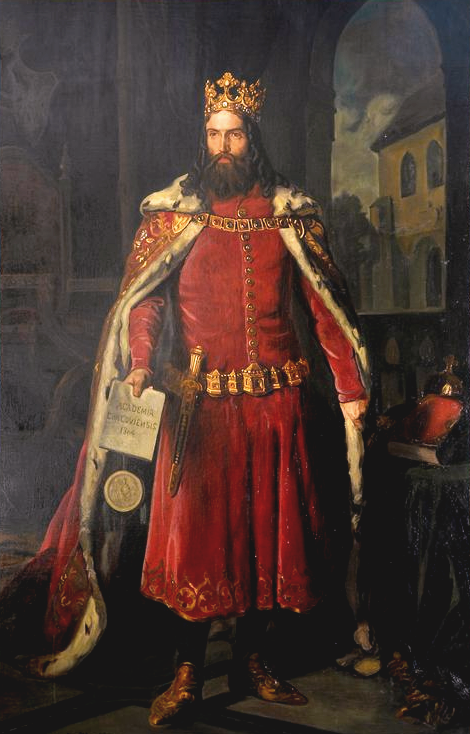
Kazimierz III the Great
The Masovia line succeeded where the rival line did not. Indeed, the title "High Duke" almost became hereditary, though it did pass to a cadet line briefly. That cadet line, like its Silesian cousins, outlived the senior Masovia line and even had one of its members elected King of Galicia, a small neighboring kingdom east of Poland (and later incorporated into Poland). From Władysław I to the end of the dynasty, the title remained with the Masovia line. Władysław's son, Kazimierz managed to negotiate with the Holy Roman Empire for a permanent title of king, which he succeeded in obtaining. Regretably, he was the last of his line to rule, though. His cousin, Władysław of Gniewkowo, was the next closest male-line relative but was passed over in favor of Kazimierz's nephew, Louis I, a member of the French House of Capet-Anjou. Louis himself failed to sire a son and the title passed to his own daughter, Hedwig, who took the Polish name Jadwiga and became the first female king of Poland. Her husband, Jogaila of Lithuania, brought together the Polish and Lithuanian crowns and it is from him that the next two century's kings descent. When Jogaila died, he did marry Kazimierz's granddaughter, Anna, but no further dynastic unions were necessary to justify his claim to the Polish throne.

The Polish-Lithuanian Commonwealth at the time of its creation, 1436. Poland is in red (dark and light) and Lithuania is in pink (both dark and light). They were formally unified in 1440.
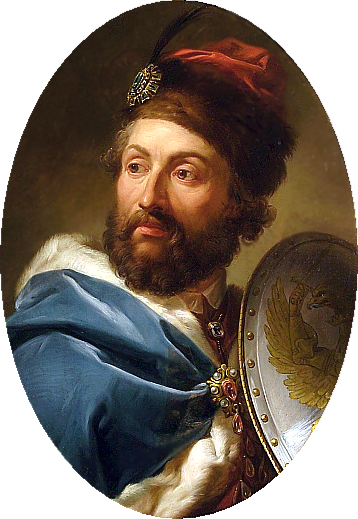
Kazimierz IV
Thus, dynastic politics ruined Poland, allowing an outsider to take both the throne and the lands from the Polish people. While the resulting Polish-Lithuanian Commonwealth, officially established by Jogaila's son, Kazimierz IV, unified two neighboring lands and created one of the largest Early Modern state in Europe, it did so at the expense of the Piast Dynasty, which continued to live for another two centuries as vassals of Polish, Bohemian, and Imperial rulers. The many failures of the family demonstrates the need for firm succession rules that are both easy to follow and acceptable to all parties. Had Bolesław III in 1138 realized the chaos that would ensue because of his succession system, perhaps he would have divided his lands differently and accepted that a unified country is stronger than dividing lands to satisfy one's sons.

Monday, December 31, 2012

[December 31] Commodus, emperor of Rome

Full Name: Marcus Aurelius Commodus Antoninus
Parents: Marcus Aurelius, emperor of Rome, and Faustina the Younger
Date of Birth: 31 August 161
House: Antonine
Spouse(s): Bruttia, daughter of Gaius Bruttius Praesens, consul of Rome
Predecessor: Marcus Aurelius
Reign: 180 – 192
Brief: Commodus was one of few heirs born to a reigning emperor before the era of Constantine in the 300s. His elder twin, Titus, died at the age of four and Commodus became sole heir. He was elected caesar with his younger brother in 166. In 175, Commodus joined the college of pontiffs and entered public life. Marcus Aurelius elevated his son to Augustus (co-emperor) in 177 and nominated him consul,  the youngest such Senator in history to the time. Marcus Aurelius died in 180 while fighting on the Danubian front, after which Commodus took control over the Roman Empire. Though often portrayed as a weak and selfish ruler, Commodus' reign is, in fact, poorly documented and it did not lead directly to the fall of Rome nearly two centuries later. His reign was externally peaceful, signing a treaty with the Danube tribes and relegating the government to loyal advisors. Throughout his reign, Commodus dealt with assassination attempts, attempted coups, and upstart usurpers, forcing him to become more directly involved in his government. Until 188, Commodus left the government under the management of a man named Cleander, whose mismanagement of affairs led to famine and his eventual beheading by Commodus. Commodus' megalomania peaked in 191 following a fire that destroyed much of the city of Rome. The emperor proclaimed a new Rome and himself, a new Romulus. He renamed the city, the months of the year, the legions, the fleet, the Senate, and even the people. On 31 December 192, after a failed poisoning, Commodus was strangled to death in his bath by a former wrestling partner. The city and everything was restored to Rome, though Commodus was later, under Septimus Severus, deified as per the standard procedures of the day. His death prompted the Year of the Five Emperors in 193.
Date of Death: 31 December 192
Successor: Pertinax

Other Monarchs Who Died Today:
  • St. Silvester I, pope of Rome (335)
  • Ottokar III, margrave of Styria (1164)
  • Leopold V, duke of Austria (1194)
  • Frederick III, duke of Lorraine (1302)
  • Shimazy Tadayoshi, daimyo in Japan (1568)
  • Dorgon, emperor of China (1650)
  • Charles III Philip, count palatine of the Rhine (1742)
  • Sabah III Al-Salim, emir of Kuwait (1977)

Sunday, December 30, 2012

[December 30] Ferdinand Charles, archduke of Further Austria

Parents: Leopold V, archduke of Further Austria, and Claudia de' Medici
Date of Birth: 17 May 1628
House: Habsburg
Spouse(s): Anna de' Medici, daughter of Cosimo II, grand duke of Tuscany, and Maria Magdalena of Austria
Predecessor: Leopold V
Reign: 1630 – 1662
Brief: During the 16th and 17th centuries, the archduchy of Austria was divided up among rival cadet branches of the family. Ferdinand Charles was delegated ruler of Further Austria based out of Tyrol near the Italian border. For the first sixteen years of his rule, he was a minor and his mother, Claudia de' Medici, ruled in his name until 1646. Once he became archduke, Ferdinand Charles ruled with an iron fist. He dissolved the Tyrolian Diet in 1648 and executed his chancellor in 1651, ruling alone afterwards. He enjoyed a luxurious lifestyle and paid for it by selling titles of nobility and family heirlooms under his care. He was paid a portion of gold from France for lands ceded to France in a previous war—he wasted all of this on luxuries. For all his greed, Ferdinand Charles was a lover of Italian opera and had an opera house at his court for performances. When he died in 1662, few mourned his passing and his brother, Sigismund Francis, bishop of Augsburg, Gurk, and Trent, inherited Further Austria.
Date of Death: 30 December 1662
Successor: Sigismund Francis

Other Monarchs Who Died Today:
  • Felix I, pope of Rome (274)
  • Richard II, pretender to England (1460)
  • Innocent IV, pope of Rome (1591)

Saturday, December 29, 2012

[December 29] Spotted Elk, chief of the Miniconjou Sioux

Chief Spotted Elk dead after the Wounded Knee Massacre, 1890.
Sobriquet: "Big Foot" (Sithanka)
Local Name: Unpan Gleská
Parents: One Horn, chief of the Miniconjou Lakota Sioux
Date of Birth: 1826
House: Miniconjou
Predecessor: One Horn
Reign: 1877 – 1890
Brief: Tragedy dominated the life of Spotted Elk. He was known as a peaceful leader of his tribe of Lakota Sioux, and was renown for his diplomatic successes with the American government. He was also well-known among his own people, often being called upon to resolve intertribal disputes. Prior to his elevation to chief, Spotted Elk fought in the Great Sioux War of 1876, allied with Chief Sitting Bull and Crazy Horse, though his tribe eventually surrendered to the US Army. Once relocated to a reservation, Spotted Elk encouraged sustainable agriculture and the building of schools. He advocated peace with American settlers, and was the first Native American to raise corn to US governmental standards. But economic deprivation still dominated the reservation, and Spotted Elk fell under the sway of Wavoka, who led the "Ghost Dance" movement. The government had outlawed the Ghost Dance but it spread throughout the Lakota Sioux tribes like wildfire. Fearing the government, Spotted Elk took his tribe as well as the remnants of Sitting Bull's tribe to the Pine Ridge Reservation in the hope that through unity, peace could be achieved. But peace was not to come. Major Samuel M. Whitside of the 7th US Cavalry intercepted the fleeing natives and arrested them, taking them to Wounded Knee Creek. On the morning of December 29, 1890, a gunshot went off prompting a retaliatory strike by the US Army, killing 200 men, women, and children, including Chief Spotted Elk. The Wounded Knee Massacre remains one of the bloodiest and worst US atrocities against the American Indians and the Miniconjou Lakota Sioux never recovered from the bloodshed.
Date of Death: 29 December 1890

Other Monarchs Who Died Today:
  • Gemmei, empress of Japan (721)

Friday, December 28, 2012

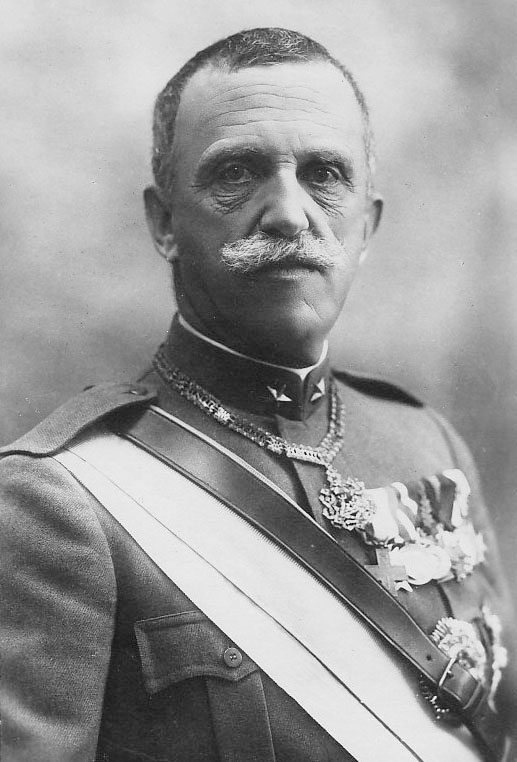
[December 28] Victor Emmanuel III, king of Italy

Local Name: Vittorio Emanuele
Parents: Umberto I, king of Italy, and Margherita of Savoy
Date of Birth: 11 November 1869
House: Savoy
Spouse(s): Elena, daughter of Nikola I, king of Montenegro, and Milena Vukotic
Predecessor: Umberto II
Reign: 1900 – 1946
Brief: Italy's fourth king since the peninsula's unification in the 1860s, Victor Emmanuel III was arguably one of the weakest rulers. Small in stature (barely 5 feet), he overcompensated by directly involving himself in the constitutional monarchy over which he ruled. Between 1900 and 1922, he intervened in ten separate parliamentary crises. Although at first against joining World War I, in 1915 he personally brought Italy into the Triple Entente with France, Britain, and Russia. The Italians remained staunchly against the war, but didn't hold a grudge against the king since he often visited the front lines in the north with his wife, endearing the people to the royal family. After the war, Benito Mussolini staged a march on Rome, quickly becoming prime minister and leader of the government. By 1926, Mussolini was in charge of all branches of government and pressing his fascist agenda, while Victor Emmanuel remained silent. He remained popular to the masses even though he sided with the fascists, but when he assumed the crowns of Ethiopia and Albania in the late 1930s, his popularity plummeted. In 1940, Mussolini dragged Italy into World War II, and as Italy quickly lost battles, so too did Victor Emmanuel lose supporters. Three years later, Mussolini was removed from office and Italy publicly joined the Allies. The Germans swarmed into Italian conquered territories and northern Italy, forcing the king to flee south. By 1944, Victor Emmanuel had passed much of his power to his son, Umberto. Finally, in 1946, the king abdicated in the hope that the Italian monarchy would survive if he were not leading the country. It failed. Umberto II ruled for less than a month and then the family was forced into exile to Egypt. Victor Emmanuel III died in 1947 in Alexandria and was buried there.
Date of Death: 28 December 1947
Successor: Umberto II

Other Monarchs Who Died Today:
  • Theonas, patriarch of Alexandria (300)
  • Yoshiakira, shogun of Japan (1367)
  • Clement VIII, antipope of Rome (1446)
  • Piero, patriarch of Florence (1503) -
  • Mary II, queen of England & Scotland (1694)
  • Mustafa II, sultan of the Ottoman Empire (1703)

Thursday, December 27, 2012

[December 27] George, margrave of Brandenburg-Ansbach

Sobriquet: "The Pious" (Der Fromme)
Parents: Frederick I, margrave of Brandenburg-Ansbach, and Sophia of Poland
Date of Birth: 4 March 1484
House: Hohenzollern
Spouse(s): (1) Beatrice, daughter of Bernardin, prince of Krk & Modrus, and Donna Luisa Marzano d'Aragona, then (2) Hedwig, daughter of Charles I, duke of Münsterberg-Oels, and Anna of Sagan, then (3) Emilie, daughter of Henry IV, duke of Saxony, and Catherine of Mecklenburg
Predecessor: Frederick I
Reign: 1536 – 1543
Brief: Young and a third son of his father, Frederick, George decided early on to enter the service of his uncle, King Vladislaus II of Bohemia and Hungary, at the age of twenty-two. He rose in ranks quickly and was placed in charge of the duchy of Oppeln in 1515. The next year, we was elected to the Hungarian council of state and became tutor for the future King Louis II. George became the leader of one of the political factions within Hungary, fighting against the faction of the Magyar. Within a few years of the preachings of Martin Luther, George became a convert to Lutheranism and began allowing its spread in northern Hungary (Slovakia) and within his own home of Ansbach. He fought with his elder brother, Casimir, for many years until 1536, when Casimir died and George could spread Lutheranism without resistance. George remained a close friend of Luther and wrote to him frequently. In 1529, he met John of Saxony and they agreed to form a German league of Protestants in the north. George attended numerous meetings between imperial and Protestant delegates, as well as councils between the church and Lutherans, but he died leaving much undone. His legacy in the Reformation is nearly as strong as that of John of Saxony, though he is much less remembered.
Date of Death: 27 December 1543
Successor: George Frederick

Other Monarchs Who Died Today:
  • Zosimus, pope of Rome (418)
  • Svyatoslav II, grand prince of Kiev (1076)

Wednesday, December 26, 2012

[December 26] Galeazzo, duke of Milan

Parents: Francesco, duke of Milan, and Bianca Maria Visconti
House: Sforza
Spouse(s): (1) Dorotea, daughter of Ludovico II, marquess of Mantua, and Barbara of Brandenburg, then (2) Bona, daughter of Louis, duke of Savoy, and Anne of Cyprus
Predecessor: Francesco I
Reign: 1466 – 1476
Brief: Galeazzo was leading a military expedition in France against Burgundy when he heard that his father had died, leaving him the duchy of Milan. Returning to Milan, Galeazzo was forced to assume a false identity to pass through Savoy, home of the family's rival. Though ruling jointly with his mother during the first year of his reign, Galeazzo ended up ousting her to rule alone. A great lover of music, Galeazzo was known more for his cruelty. He was a rabid womanizer and was known to torture anyone who spoke against him. Surprisingly, he ruled for ten years before high-ranking members of the Milanese court had him assassinated. His eldest son succeeded him.
Date of Death: 26 December 1476
Successor: Gian Galeazzo

Other Monarchs Who Died Today:
  • Dionysius, pope of Rome (268)
  • Zosimus, pope of Rome (418)
  • Arthur III, duke of Brittany (1458)
  • Babur, sultan of the Moghul empire (1530)

Tuesday, December 25, 2012

[December 25] Suraq Mal, maharaja of Bharatpur

Local Name: महाराजा सूरज मल
Parents: Badan Singh, maharaja of Bharatpur, and Rani Devki of Jat
Date of Birth: February 1707
House: Sinsinwar Jat
Spouse(s): (1) Kishori, daughter of Chowdhary Kashi Ram Jat of Hodal, (2) Hansia, daughter of Chowdhary Rati Ram Jat of Salempur, (3) Ganga, (4) Kalyani, (5) Gauri, (6) Khattu, and others
Predecessor: Badan Singh
Reign: 1756 – 1763
Brief: The kingdom of Bharatpur was a recent creation of the Mughal Empire when Suraq Mal succeeded his father, who had served as the first raja. Suraq Mal entered history in 1730 building fortresses to protect the cities of Deeg and Kumher. He would continue these projects far into his reign. By 1746, Suraq Mal was the real power behind the throne and the leader of the Bharatpur army. He expanded outward from their small base, conquering and annexing large swaths of land in northwest India. By 1754, he had sacked Delhi but declined usurping the Moghul throne since he shared enemies with the Moghul emperor. He continued his fight against his neighbors for his entire life, eventually dying in an ambush. As maharaja, he brought wealth and prestige to the state and built many fortresses that still exist today. He never wavered in his resolve and some modern writers have called him "the Plato of the Jat people" and the "Jat Odysseus" because of his vast campaigns. Today, the Jat people can claim at least a part of their higher status in Indian society to the successes of Suraq Mal.
Date of Death: 25 December 1763
Successor: Jawahar Singh

Other Monarchs Who Died Today:
  • Adrian I, pope of Rome (795)
  • Leo V, emperor of Constantinople (820)
  • Taisho, emperor of Japan (1926)

Monday, December 24, 2012

[December 24] John I, count of Hainaut

Parents: Bouchard IV, lord of Avensnes, and Margaret II, countess of Flanders
Date of Birth: 1 May 1218
House: Avesnes
Spouse(s): Adelaide, daughter of Floris IV, count of Holland, and Matilda of Brabant
Predecessor: Margaret II
Reign: 1246 – 1257
Brief: The legitimate, though declared illegitimate, son of the countess of Flanders, John fought an uphill battle much of his life to achieve Imperial legitimacy for his claim to Hainaut. When Margaret produced a son, William, with her second husband in 1244, proclaiming him her heir, John and his brother, Baldwin, declared war, sparking the War of the Succession of Flanders & Hainaut. The conflict only ended in 1246 when King Louis IX of France forced a settlement. The inheritance was split, with John gaining Hainaut and William, Flanders. But Margaret would not relinquish her control over Hainaut, and John paid for the assassination of William as revenge in 1251. Another son, Guy, continued William's claim and the war restarted, ending in 1253 with the defeat of the Flanders faction at the Battle of West-Capelle. Margaret decided to sell her rights to Charles, duke of Anjou, rather than give them to John, but John's brother-in-law was the German king and fought against Charles to secure John's succession. John only briefly held Hainaut undisputedly, dying in late 1257, only a month after the final settlement. His son inherited both Hainaut and Holland and continued fighting to gain Flanders as well.
Date of Death: 24 December 1257
Successor: John II

Other Monarchs Who Died Today:
  • Sisinnius I, archbishop of Constantinople (427)
  • Go-Sakuramachi, empress of Japan (1813)
  • Duarte II, pretender to Portugal (1976)

Sunday, December 23, 2012

[December 23] Huneric, king of the Vandals

Parents: Genseric, king of the Vandals
House: Vandal
Spouse(s): Eudocia, daughter of Valentinian III, emperor of Rome, and Licinia Eudoxia
Predecessor: Genseric
Reign: 477 – 484
Brief: Successor to his father, Genseric, Huneric quickly married the daughter of the Roman Emperor Valentinian III to secure his powerbase. Unfortunately, it did not hold. By 472, she had already left him. Huneric, meanwhile, had claimed the kingship of the Vandals, as well as the Alans, another Germanic migrant group. While they were dispossessed of all land in Europe, the Vandals maintained control over the Mediterranean and its western islands, seeking to find allies among the Roman diaspora. A staunch Arian, Huneric fought off-and-on against Catholics within his lands, frequently banishing Catholic leaders to border areas. In February 484, he called for a synod to resolve Catholic-Arian disputes, but he captured all the Catholics and exiled them to Corsica, killing a few that refused the exodus. When he died later that year, few mourned his death and some Moors used his cruelty as an exuse to rebel from Vandal rule. A nephew, Gunthamund, succeeded him.
Date of Death: 23 December 484
Successor: Gunthamund

Other Monarchs Who Died Today:
  • Dagobert II, king of Austrasia (679)
  • Conrad I, king of Germany (918)

Saturday, December 22, 2012

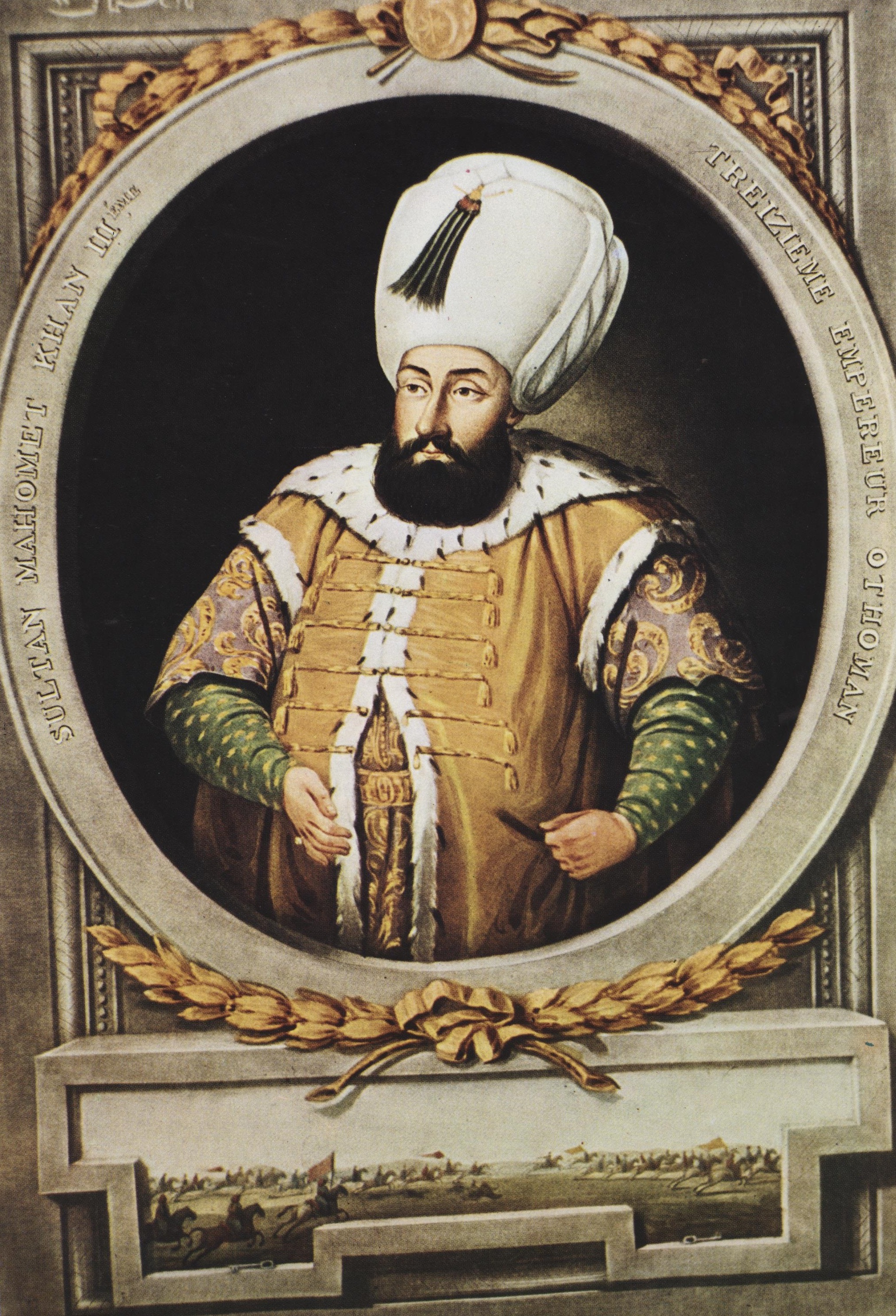
[December 22] Mehmed III, sultan of the Ottoman Empire

Local Name: محمد ثالث (Meḥmed-i sālis)
Parents: Murad III, sultan of the Ottoman Empire, and Safiye Sultan
Date of Birth: 26 May 1566
House: Osman
Spouse(s): Handan Sultan
Predecessor: Murad III
Reign: 1595 – 1603
Brief: Nothing is known of the life of Mehmed before he began his fight to gain the Ottoman throne. His father died in 1595 and Mehmed immediately began to kill off his rivals, all brothers, to secure the throne for himself. Despite his eventual execution of nineteen brothers, Mehmed was a lazy ruler who did little himself. His mother, Safiye Sultan, ruled for him even during the Austro-Ottoman War. Forced to take command of his army early in his reign, Mehmed found victory at the Battle of Keresztes, though he tried to flee midway through the battle. It was the only time he fought in battle. A large envoy from England delivered many English gifts, but Mehmed was only somewhat impressed and, after seeing an English warship, decided it was time to rebuild the Ottoman fleet. Although aloof and uninterested in the arts, Mehmed's reign was a strong continuation of his predecessor's and little land was lost or gained during it. His son, Ahmed I, succeeded him relatively peacefully upon his death in 1603, though a younger son, Yahya, converted to Christianity and sought an alliance with the west to restore the Middle East to Orthodoxy.
Date of Death: 22 December 1603
Successor: Ahmed I

Other Monarchs Who Died Today:
  • Vitellius, emperor of Rome (69)
  • Bretislaus II, king of Bohemia (1100)

Friday, December 21, 2012

[December 21] Henry I, landgrave of Hesse

Sobriquet: "The Child" (das Kind)
Parents: Henry II, duke of Brabant, and Sophie of Thuringia
Date of Birth: 24 June 1244
House: Brabant-Hesse
Spouse(s): (1) Adelheid, daughter of Otto I, duke of Brunswick-Lüneburg, then (2) Mechthild, daughter of Dietrich VI, count of Cleves
Predecessor: Henry Raspe (as landgrave of Thuringia)
Reign: 1247 – 1308
Brief: Born to Sophie of Thuringia, Henry was in a unique position to inherit all of his grandfather's vast lands in Germany. But a rival, Henry of Meissen, also had a claim to the territory. After many years of intermittent fighting and feuding, it was agreed that Henry would receive Hesse, and Henry of Meissen the remainder of Thuringia and the title. But Henry had been ruling his portion since 1247 and his lands were only confirmed in 1264. Another rivalry dominated the remainder of his reign, this time with the archbishop of Mainz, Werner II. Werner sought to control the land as a ecclesiastical fief, but agreed to leave it in Henry's hands. But when Henry I sought to annex a portion of Mainz, the archbishop fought back, calling in King Rudolf I of Germany and giving Henry the boot in 1274. Henry decided to join Rudolf's forces and ingratiate himself with the German king, thereby gaining his lands back in 1276. Fourteen years later, Henry defeated the archbishop at the Battle of Fritzlar, solidifying his control over Hesse for good. King Adolf, in 1292, granted Hesse full independence from Mainz and was given additional lands, expanding his territory. Sons born of multiple mothers forced Hesse to fold into a civil war around the same time. Henry I died in 1308 with the succession issue still unresolved. Two sons eventually divided the landgraviate in 1310, while a third, Louis, became bishop of Münster.
Date of Death: 21 December 1308
Successor: Otto I (in Upper Hesse), John (in Lower Hesse)

Thursday, December 20, 2012

[December 20] Stephen IV, tsar of Serbia

Sobriquet: "The Mighty"
Local Name: Душан Силни 
Parents: Stephen III, king of Serbia, and Theodora Smilets of Bulgaria
Date of Birth: circa 1308
House: Nemanjic
Spouse(s): Helena, daughter of Sratsimir of Kran and Keratsa Petritsa
Predecessor: Stephen III
Reign: 1346 – 1355
Brief: Stephen IV Dusan was the declared heir to the Serbian throne in 1322 after his father defeated Stephen Constantine in a contest for the throne. During his earlier years, Dusan lived in Constantinople where he learned Greek and Byzantine culture. In his twenties, he fought in two major battles and gained a reputation as a soldier prince. In 1331, Dusan forcibly took the Serbian throne from his father after his father invaded Dusan's lands in Zeta. As king, Stephen IV looked to the east and began preparing for a major invasion of the Byzantine Empire. By 1343, Stephen was king over much of the Balkan states styling himself "King of Serbia, Albania, and the Coast", and in the next year he adopted the title tsar (emperor). He formalized this later that year proclaiming himself "Tsar of the Serbs and Romans", which he followed with a major coronation ceremony the next year. This declaration ended up being the Byzantine Empire's downfall, for in response, the Empire sought the aide of the Ottoman Turks of Anatolia and invited them to invade the Balkans. While the Turks made inroads in Greece, the Serbs captured several northern cities that were near to Constantinople. Stephen then moved west to conquer Bosnia while the Empire recaptured much of their lost land on its borders. Stephen was preparing a renewed assault against the Turks when he died unexpectedly in 1355. His son and successors could not maintain the large empire and it fell to pieces. A daughter, Theodora, married Orhan I, an Ottoman sultan, and is one of the few confirmed links between the Ottomans and European dynasties.
Date of Death: 20 December 1355
Successor: Stephen V

Other Monarchs Who Died Today:
  • Zephyrinus, pope of Rome (217)
  • Æthelbald, king of Wessex (860)
  • Alfonso III, king of León (910)
  • Kangxi, emperor of China (1722)

Wednesday, December 19, 2012

[December 19] Thibaw Min, king of Burma

Local Name: သီပေါ‌မင်း
Parents: Mindon, king of Burma, and a princess from Laungshe
Date of Birth: 1 January 1859
House: Konbaung
Spouse(s): Supayalat, daughter of Mindon, king of Burma, and Hsinbyumashin
Predecessor: Mindon
Reign: 1878 – 1885
Brief: Early in his life, Thibaw's mother was exiled and the young prince studied Buddhist scriptures furiously to win his father's favor. Eventually, he did, and his father gave him a half-sister, Supayalat, as his wife and future consort. In 1878, most of the royal family was killed in a purge led by Queen Hsinbyumashin, who wanted to secure the throne for her daughter and step-son. Relations with the United Kingdom were tense during Thibaw's reign. Lower Burma was under direct British control, and Britons were banished from the rest of Burma after British diplomats showed disrespect to the king. In 1885, Thibaw called for the recovery of Lower Burma, prompting war with Great Britain. It only took a day for the British to march into the Mandalay Palace and demand the surrender of King Thibaw Min and his government. Cowering, the king surrendered and was forced into exile in India where he spent the rest of his life at a small palace in Ratnagiri on a government pension. Thibaw Min was the last monarch of Burma and some of his descendants, including his eventual heir, once again live in Myanmar (Burma).
Date of Death: 19 December 1916
Successor: Myat Phaya Lat (as pretender)

Other Monarchs Who Died Today:
  • Geta, emperor of Rome (211)
  • Anastasius I, pope of Rome (401)
  • Urban V, pope of Rome (1370)
  • James Louis, pretender to Poland (1737)
  • Abbas II, king of Egypt (1944)

Tuesday, December 18, 2012

[December 18] Alfonso II, king of Naples

Parents: Ferdinand I, king of Naples, and Isabella of Taranto
Date of Birth: 4 November 1448
House: Trastámara
Spouse(s): Ippolita Maria, daughter of Francesco I, duke of Milan, and Bianca Maria of Milan
Predecessor: Ferdinando I
Reign: 1494 – 1495
Brief: Though barely considered a ruler of Naples, the long regency he held during his father's late illness gave Alfonso considerable power and influence. A close relative to the kings of Aragón, Alfonso was also the direct heir to the Brienne claim to the kingdom of Jerusalem, which fell to him in 1465. Unfortunately, by the time Alfonso ascended the throne in 1494, he had little to show for it. The Papacy had been attempting to annex Naples for centuries and the constant warfare had drained the accounts in Naples. When Ferdinando I died, King Charles VIII of France was already marching south to invade and claim the land, which had been offered to him by Pope Alexander VI. Alexander VI reasserted his faith in Alfonso soon after, though, but it was too late: Charles was already at the doorstep of Naples. Alfonso's fleet and army were destroyed and the king fled, abdicating in favor of his son, Ferdinando II. The retired king died in a monastery later that year. Though his reign was short, Alfonso was a patron of the arts while he served as crown prince and his palace heavily influenced Charles when he briefly occupied the city.
Date of Death: 18 December 1495
Successor: Ferdinando II

Other Monarchs Who Died Today:
  • Magnus I, king of Sweden (1290)

Monday, December 17, 2012

[December 18] Nzinga, queen of Ndongo and Matamba

Full Name: Nzingha a Mbande
Parents: Kiluangji, king of Ndongo and Matana, and Kangela
Date of Birth: circa 1583
Predecessor: Mbande
Reign: 1624 – 1663
Brief: Though a woman, Nsinga was destined to rule her people. Her father, Kiluanji, kept her close during his political councils and even took her with him when he went to war. She enters history as an envoy for her brother, Mbande, to the Portuguese, who were spreading their slave empire into Angola. She argued favorably against certain improprieties and the two nations signed an equal treaty. To strengthen the treaty, Nzinga converted to Christianity and took the name Anna de Sousa. Unfortunately, the Portuguese did not hold up their end of the bargain, and King Mbande committed suicide out of regret. Nzinga claimed the regency for her son, Kaza, but he died soon after, at which time Nzinga claimed the throne for herself. In the 1640s, Nzinga made an alliance with the Netherlands against the Portuguese, fighting against them successfully in 1644 before being defeated two years later.  In 1647, with Dutch help, Nzinga defeated a Portuguese army and laid siege to their chief city in Masangano. This back-and-forth war continued throughout her reign, and Nzinga continued to personally lead her armied well into her sixties. By 1657, though, she was tired and agreed to peace with Portugal. In her last years, she devoted herself to Christianity and died quickly at the age of eighty in 1663. 
Date of Death: 17 December 1663
Successor: Francisco Guterres Kanini

Other Monarchs Who Died Today:
  • Ankan, emperor of Japan (535)
  • William I, duke of Normandy (942)
  • Gregory VIII, pope of Rome (1187)
  • Baldwin V, count of Hainaut (1195)
  • Leopold II, king of Belgium (1909)
  • Thubten, Dalai Lama of Tibet (1933)

Sunday, December 16, 2012

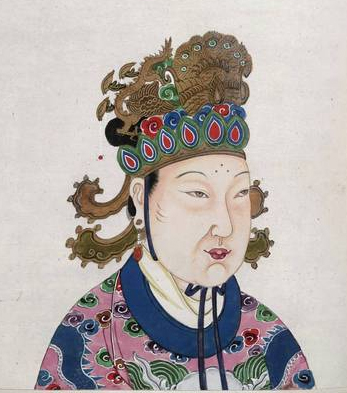
[December 16] Wu, empress of China

Local Name: Wǔ Zétiān (武則天)
Parents: Wu Shihu, duke of Ying, and Yang
Date of Birth: 17 February 624
House: Zhou
Spouse(s): (1) Taizong, emperor of China, then (2) Gaozong, emperor of China
Predecessor: Wang
Reign: 690 – 705
Brief: China's only empress regnant and a blatant usurper who named her dynasty the "Zhou Dynasty", Empress Wu is a rather unique figure in Chinese history. She came to power through her companionship with Emperor Taizong of the Tang Dynasty, who had her as a concubine. When the emperor died prematurely, she married his son and successor, Gaozong, becoming his first and foremost wife. When the emperor had a stroke in 660, she claimed the regency for him. When Taizong died in 683, she continued as regent for their son Zhongzong. When Zhongzong began to rebel the next year, she deposed her son and installed Ruizong, her youngest son, in his place. She then began a purge of all rival members of the Tang dynasty, either killing them or forcing them to commit suicide. In 690, she deposed her son and claimed the throne for herself, destroying the traditional order of succession established a thousand years before. As empress, she elevated Buddhism over Taoism across China, and built temples for it. She then began expanding the empire outward in all directions, especially strengthening the garrisons in the north. Throughout her fifteen-year reign, Wu fought against rivals, intrigues, and outside attacks, but in the end, expanded China to one of its broadest extents since Han times. She became ill in 705 and was forced to abdicate, dying later that year. Though a usurper, Tang historians decided nevertheless to honor her memory and she and her dynasty entered the record books as Wu of Zhou, empress regnant of China. 
Date of Death: 16 December 705
Successor: Wei

Other Monarchs Who Died Today:
  • Eberhard, duke of Friuli (867)
  • Charles, titular emperor of Constantinople (1325)
  • Otto III, margrave of Montferrat (1378)
  • John II, duke of Lorraine (1470)
  • Leopold II, prince of Anhalt-Dessau (1751)
  • Nam, emperor of Vietnam (1963)

Saturday, December 15, 2012

[December 15] Alp Arslan, shah of Persia

Local Name: Muhammad bin Dawud Chaghri (آلپ ارسلان)
Sobriquet: "Alp Arslan" (Heroic Lion)
Parents: Chaghri Beg, governor of Khorasan
Date of Birth: 20 January 1029
House: Seljuq
Spouse(s): Aka
Predecessor: Toghrul I
Reign: 1063 – 1072
Brief: Though raised as the grandson of the first Seljuq shah, Alp Arslan began his career as a regional governor in Khorasan. A conflict broke out when his uncle, Toghrul I, died leaving the Seljuq throne open to a brother, Kutalmish, and Alp Arslan. After five years of civil warfare, Alp Arslan finally defeated his uncle and became the sole ruler of Persia. As one of his first moves, he appointed his son, Malik, his heir and successor, to avoid future civil war. He followed the civil war with an expansion campaign, quickly defeating and conquering Armenia and Georgia and annexing them to his empire. In 1068, Alp Arslan pushed into the Byzantine Empire, being defeated in 1070. In 1071, the Byzantines counter-attacked but at the Battle of Manzikert, a large contingent of Byzantine soldiers defected to the Persians, routing the Byzantine army. In the battle, he captured Emperor Romanos IV Diogenes and then released him, with a heavy life debt and guilt. Most of Anatolia fell under Seljuq authority, establishing the current Turkish presence in the peninsula. Alp Arslan reformed the bureaucracy of Persia to make it more stream-lined between Turkish nomads and sedentary Persians. He placed his relatives as governors throughout the lands to satisfy and pacify them. Alp Arslan was in the midst of a campaign to retake Turkestan, the Turkish homeland, when a defeated prince drew a dagger and killed the shah. Alp Arslan's attacks against the Byzantines forced them to call for help from the West, prompting the First Crusade.
Date of Death: 15 December 1072
Successor: Malik-Shah I

Other Monarchs Who Died Today:
  • Basil II, emperor of Constantinople (1025)
  • Otakar I, king of Bohemia (1230)
  • Håkon IV, king of Norway (1263)

Labels

[brief] (102) female monarch (31) Capet (26) [abbreviated] (19) Roman Empire (17) Great monarchs (16) Japan (15) Papacy (15) England (13) saints (13) France (11) Portugal (11) [Missing Deaths] (11) Habsburg (10) Sweden (10) Byzantine Empire (9) Carolingian (9) China (9) Hohenzollern (9) Oldenburg (9) Holy Roman Empire (8) Japan (dynasty) (8) Aragón (7) Austria (7) Denmark (7) Electorate (7) Ethiopia (7) Hungary (7) Navarre (7) Norway (7) Romanov (7) Russia (7) Saxony (7) Scotland (7) Wettin (7) Wittelsbach (7) Bavaria (6) Burgundy (6) Egypt (6) Italy (6) Lorraine (6) Luxembourg (6) Persia (6) Poland (6) Sicily (6) Spain (6) Valois (6) Capet-Burgundy (5) Franks (5) Germany (5) Plantagenet (5) Prussia (5) Quraish (5) Solomon (Ethiopia) (5) Tuscany (5) Anjou (4) Aquitaine (4) Barcelona (dynasty) (4) Bohemia (4) Brittany (4) Burgundy-Aviz (4) Burma (4) Capet-Valois (4) Castile (4) Constantinople (Patriarchate) (4) Habsburg-Lorraine (4) Holstein-Gottorp-Romanov (4) India (4) Ireland (4) Jerusalem (4) Jiménez (4) Kiev (4) Mongolia (4) Naples (4) Netherlands (4) Normandy (4) Osman (4) Ottoman (4) Palaeologos (4) Savoy (4) Savoy (dynasty) (4) Trastámara (4) Wales (4) Afghanistan (3) Albania (3) Bagrationi (3) Banu Hashim (3) Blois (3) Borjigin (3) Bourbon (3) Brabant-Hesse (3) Brandenburg (3) Capet-Bourbon (3) Cologne (3) Croatia (3) Cyprus (3) Disney (3) Fairhair (3) Georgia (3) Gwynedd (3) Hainaut (3) Hesse (3) Hohenstaufen (3) Holland (3) Holstein-Gottorp (3) Inca (3) Islam (3) León (3) Limburg (3) Lithuania (3) Livonia (3) Lothier (3) Macedonia (dynasty) (3) Mainz (3) Mann (3) Medici (3) Morocco (3) México (3) Nassau (3) Nguyễn (3) Serbia (3) Stuart (Stewart) (3) Toungoo (3) Tudor (3) Turkey (3) Vaudemont (3) Vietnam (3) Welf (3) Wessex (3) published articles (3) Abberfraw (2) Aberffraw (2) Alexandria (patriarchate) (2) Angevins (2) Anglo-Saxon (2) Ardennes-Metz (2) Auvergne (2) Ayyubid (2) Basarab (2) Bernadotte (2) Billung (2) Boulogne (2) Brabant (2) Bruce (2) Burgundy-Bragança (2) Caliphate (2) Cilicia (2) Constantine (2) Crovan (2) Denmark (Dynasty) (2) Draculesti (2) Dreux (2) Dunkeld (2) Dutch Republic (2) Estridsen (2) Flanders (2) Florence (2) Further Austria (2) Greece (2) Habsburg-Spain (2) Hanover (2) Hardrada (2) Hauteville (2) Hawai'i (2) Ivrea (2) Joseon (2) Karadordevic (2) Konbaung (2) Korea (2) Maya (2) Merovingian (2) Milan (2) Ming (2) Monaco (2) Nassau-Orange (2) Nassau-Weilburg (2) Norman (2) Novgorod (2) Orange (2) Ottonian (2) Piast (2) Piedmont-Savoy (2) Poitiers (dynasty) (2) Robertian (2) Romania (2) Rurik (2) Sardinia (2) Saxe-Coburg-Gotha (2) Seljuk (2) Siam (2) Syria (2) Teutonic Knights (2) Thailand (2) Theodosian (2) Thuringia (2) Timurid (2) Tokugawa (2) United Kingdom (2) Valois-Burgundy (2) Vandal (2) Venice (2) Visconti (2) Vladimir (2) Wallachia (2) Württemberg (2) York (2) Yugoslavia (2) Zeeland (2) the Britons (2) 18th Dynasty (Egypt) (1) Abbasid (1) Adal (1) Agiad (1) Akinyele (1) Al Khalifa (1) Al-Said (1) Alawiyya (Egyptian) (1) Albret (1) Algeria (1) Algonquian (1) Amber (1) Angola (1) Anjou (dynasty) (1) Anjou-Hungary (1) Ansbach (1) Antonia (1) Antonine (1) Apulia (1) Arabia (1) Armenia (1) Arpad (1) Arsacid (1) Asen (1) Ashikaga (1) Athens (1) Avesnes (1) Avignon Papacy (1) Aviz-Beja (1) Aztec Empire (1) Baden (1) Bahrain (1) Balti (1) Barakzai (1) Barazkai (1) Barcelona (1) Battenberg (1) Belgium (1) Bengal (1) Berg (1) Berg (dynasty) (1) Bernicia (1) Bharatpur (1) Bhutan (1) Bjelbo (1) Bonaparte (1) Bonde (1) Bonngau (dynasty) (1) Borghese (1) Borja (1) Bosnia (1) Bourbon-Two Sicilies (1) Brandenburg-Ansbach (1) Brienne (1) Brutus (1) Bukhara (1) Bulgaria (1) Canossa (1) Capet-Dreux (1) Carthage (1) Celje (1) Celje (dynasty) (1) Chakri (1) Champagne (1) Champagne (dynasty) (1) Chartres (1) Cometopuli (1) Contantine (1) Cordoba (1) Craiovesti (1) Crusader States (1) Dalmatia (1) Damascus (1) Danesti (1) Debeubarth (1) Deira (1) Deira (dynasty) (1) Denmar (1) Dulo (1) Díaz (1) Early Han (1) East Anglia (1) East Francia (1) Eastern Han (1) Eastern Jin (1) Egmont (1) Estonia (1) Farnese (1) Fatimid (1) Fatimid Caliphate (1) Flanders (dynasty) (1) Flavian (1) Friuli (1) Gausi (1) Geneva (1) Geneva (dynasty) (1) Gordiani (1) Grimaldi (1) Guelders (1) Guideschi (1) Gwent (1) Gwynedd (dynasty) (1) Gyatso (1) Haag (1) Hainaut (dynasty) (1) Hanan Cuzco (1) Hashim (1) Hashimite (1) Hebrides (The Isles) (1) Hellenes (1) Herat (1) Hohenzollern-Ansbach (1) Hohenzollern-Sigmaringen (1) Holland (dynasty) (1) Hunfriding (1) Ibadan (1) Iran (1) Iturbide (1) Jaipur (1) Jin (1) Jordan (1) Julio-Claudian (1) Jungingen (1) Justinian (dynasty) (1) Kachwaha (1) Kalakaua (1) Kamehameha (1) Karrani (1) Kent (1) Kent (house) (1) Kestutis (1) Khurasan (1) Knights Templar (1) Komnenos (1) Kotromanić (1) Lakota Sioux (1) Lancaster (1) Latin Empire (1) Lebanon (1) Leuchtenberg (1) Lombards (1) Ludowinger (1) Lusignan (1) Luxembourg (dynasty) (1) Luxembourg-Limburg (1) Maan (1) Macedon (1) Magdeburg (1) Maine (1) Majorca (1) Malaysia (1) Manghit (1) Maratha Empire (1) Marinid (1) Matsunaga (1) Maurya (1) Mecklenburg (1) Mecklenburg-Strelitz (1) Meissen (1) Mercia (1) Mercia (dynasty) (1) Miniconjou (1) Moldavia (1) Montenegro (1) Montferrat (1) Morgannwg (1) Mortain (1) Mountbatten (1) Mughal (1) Muhammad Ali (1) Munster (1) Musat (1) Myanmar (1) Nakagawa (1) Ndongo and Matana (1) Nemanjic (1) Nepal (1) Nervo-Trajan (1) Neuchâtel (1) Nigeria (1) Nominoë (1) Northumbria (1) O'Brien (1) Obrenović (1) Odowa (1) Olgovich (1) Olympus (1) Orléans-Longueville (1) Ostrogoths (1) Ottawa (1) Pahlavi (1) Palatinate of the Rhine (1) Parma (1) Penthièvre (1) Petrović-Njegoš (1) Poděbrady (1) Pointiers (Ramnulfids) (1) Poitiers (1) Poitiers-Lusignan (1) Polignac (1) Powys (1) Prasat Thong (1) Premyslid (1) Provence (1) Přemyslid (1) Q'umarkaj (1) Qin (1) Qing (Manchu) (1) Reginar (1) Reginarid (1) Rethel (1) Rethel-Boulogne (1) Ribagorza (1) Rouergue (1) Roupenians (1) Sa Malietoa (1) Safavid (1) Salian (1) Salzburg (1) Samoa (1) Sarantapechos (1) Saud (1) Saudi Arabia (1) Second Triumvirate of Rome (1) Selangor (1) Selangor (dynasty) (1) Sforza (1) Shah (Nepal) (1) Shi'a Imamate (1) Shishman (1) Shivaji (1) Silesia (1) Simmern (1) Sinsinwar Jat (1) Skowronski (1) Slovenia (1) Sobieski (1) South Africa (1) South America (1) Sparta (1) Spoleto (1) Sture (1) Sudan (1) Sussex (1) Sverre (1) Swabia (1) Swasi (dynasty) (1) Swaziland (1) Swiss Confederation (1) Tang (1) Tenochtitlan (1) Teotihuacán (1) Terter (1) Tibet (1) Tikal (1) Tolkien (1) Toulouse (1) Tours (dynasty) (1) Transylvania (1) Tunisia (1) Umayyad (1) Unruoching (1) Valencia (1) Valois-Angoulême (1) Valois-Anjou (1) Valois-Orléans (1) Vasa (1) Vermandois (1) Visigoths (1) Vokil (1) Wangchuck (1) Wied-Neuwied (1) Windsor-Mountbatten (1) Württemberg (dynasty) (1) Yamato (1) Ying (Qin) (1) Yuan (1) Zanzibar (1) Zhao (Song) (1) Zhou (1) Zhu (1) Zogu (1) Zulu Nation (1) Zápolya (1) Zähringen (1) bretwalda (1) cardinal (1) fantasy (1) fiction (1) shogunate (1) terms (1) Árpád (1) Öuchi (1)