Monday, August 13, 2012

[August 13] Zwentibold, king of Lorraine

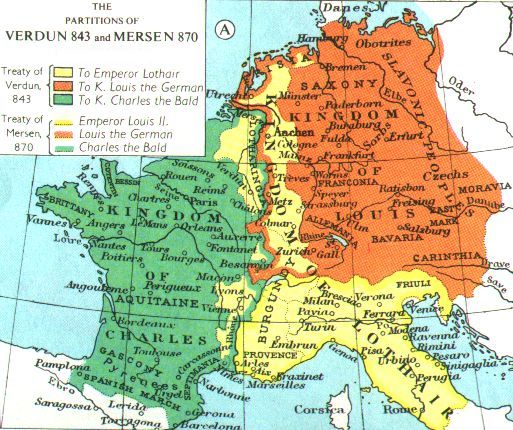
Lotharingia is the yellow area in the center between the green and orange.
Parents: Arnulf, emperor of Rome, and an unknown mistress
Date of Birth: 1 January 871
House: Carolingian

Spouse(s): Oda, daughter of Otto I, duke of Saxony
Predecessor: Lothair II
Reign: 895 – 900
Summary: Zwentibold was an unlikely last king of Lorraine, or the more appropriately named kingdom called Lotharingia, after its founder, Lothair II. Zwentibold was an illegitimate son of Arnulf, king of Germany and Roman Emperor. He first entered the political arena in West Francia when a feud broke out between Duke Odo of Paris and King Charles III the Simple. At first Zwentibold intended to act as an intermediary, but soon he began to covet the contested throne. Zwentibold had been removed from the Carolingian succession according to both the 870 Treaty of Meerssen and the 880 Treaty of Ribemont. Most of Lotharingia went to Germany. In 893, Zwentibold's hope to become his father's heir was destroyed when his father produced a legitimate son, Louis, who supplanted Zwentibold. To compensate the disenchanted princeling, Arnulf gave him Lotharingia as a sub-kingdom of Germany.


Zwentibold did little to rule Lorraine. He was an unskilled military and political leader. Failures in Italy during the previous decade had forced Zwentibold's father to step in and take control over military affairs. In Lorraine, the archbishops of Cologne and Trier contacted Arnulf rather than Zwentibold when instructions were needed. The nobility continuously called for help from Arnulf because Zwentibold preferred to help the commoners over the nobility. When Arnulf finally died in 899, Zwentibold made his power play in Lorraine, attempting to sever all ties with Germany. What actually happened, though, was that the nobility fled to Germany and requested the aid of King Louis' regents. Count Reginar I of Hainault finally killed the Lotharingian king in August 900 near the town of Susteren. Louis took over direct management of Lorraine afterwards. Lorraine would never rise to be a kingdom again and its administration fractured into several parts with the newly-named duchy of Lorraine forming out of the largest ruins of the old kingdom. Zwentibold was canonized by the Catholic Church as a martyr.
Date of Death: 13 August 900
Successor: Gebhard (as duke of Lorraine)

Sunday, August 12, 2012

[August 12] Ibrahim I, sultan of the Ottoman Empire

True Name: ابراهيم اول
Parents: Ahmed I, sultan of the Ottoman Empire, and Kösem Sultan (Anastasia)
Date of Birth: 5 November 1615
House: Osman
Spouse(s): (1) Turhan Hatice, (2) Saliha Dilasub, and (3) Hatice
Predecessor: Murad IV
Reign: 1640 – 1648
Summary: Born the younger son of the Ottoman Sultan Ahmed I, it was unfortunate that Ibrahim spent the majority of his childhood in the Kafes, a confined prison-like harem where successors to the throne were held captive. When his elder brother, Murad IV, died in 1640, Ibrahim was to be executed. Murad was the successor of a still-older brother, Osman II, who had ordered both Murad and Ibrahim executed. Thus, in a like fashion to his elder brother, Ibrahim lived on to succeed his brother and become the Ottoman sultan. In reality, Ibrahim was a rather insane sultan. In the course of eight years, he almost destroyed the empire. His mother, Kösem Sultan, ruled almost directly, without even recognizing her third son on many occasions.

Ibrahim had many strange habits that distracted him from ruling. He was obsessed with obese women, seeking large women of all types from throughout the Empire. When he heard that a man violated his harem, he had 280 concubines drowned in the Bosphorus. Also rather strangely, he fed coins to the koi that lived in his pond. Although Ibrahim avoided most politics, he was responsible for the execution of numerous viziers. He also ruled when Venice captured Tenedos, the gateway city that protected the Mediterranean entrance to the Dardanelles. Therefore, it was no surprise when this particular sultan was violently deposed in a coup in 1648. Ibrahim I was strangled to death at the request of his last grand vizier, Mevlevî, who wished to keep his job. Despite his insanity and deposition, three of his sons inherited the Ottoman throne in succession: Mehmed IV, Suleiman II, and Ahmed II.
Date of Death: 12 August 1648
Successor: Mehmed IV

Other Monarchs Who Died Today:
  • Cleopatra VII, queen of Egypt (30 BCE)
  • Louis II, Holy Roman Emperor (875)
  • Yongle, emperor of China (1424)
  • Sixtus IV, pope of Rome (1484)
  • Innocent XI, pope of Rome (1689)

Saturday, August 11, 2012

[August 11] Möngke Khan, great khan of the Mongol Empire

True Name: Мөнх хаан
Parents: Tolui, great khan of the Mongol Empire, and Sorghaghtani Beki of the Kereyid Clan
Date of Birth: 10 January 1209
House: Borjigin
Spouse(s): (1) Qutuqui of the Ikheres Clan, (2) Oghul-Khoimish of the Oirats Clan, and (3) Chubei
Predecessor: Güyük Khan
Reign: 1251 – 1259
Summary: The greatest expander of Genghis Khan's empire, Möngke was born to Genghis' son, Tolui, although he was raised by another son, Ogedei. In 1230, Möngke followed his uncle to war against the Jin Dynasty of Manchuria. His father died in 1232 and he became the ruler of Tolui's expansive khanate. In 1235, Möngke was once again sent out by his uncle to defeat the Russians and Bulgars in the Ural Mountains. After his victories there, he went south to subdue the Caucasus region. By 1240, Möngke was helping his brothers and cousins in conquering Kiev. He wished to save the city but when the defenders refused an offer of surrender, the Mongol army sacked it. Möngke returned to Mongolia in 1241 whereupon his uncle, Ogedei, died. Ogedei's son, Güyük was elected thereafter but met harsh resistance from Genghis' brother, Temuge Odchigen. Möngke and Orda Khan were to preside over the trial of Ordchigen when Güyük suddenly died in 1248. Möngke suddenly became the chief claimant to the Mongol throne. His competitor, Batu, was ill and decided to support Möngke in his bid, which allowed the young khan to become the fourth Great Khan of the Mongol Horde in succession to Genghis Khan. Up to 300 Mongol aristocrats may have died in the brief succession dispute that followed, but by 1252, Möngke was the uncontested ruler of the Horde.

Möngke was most instrumental in the safe passage afforded to the Silk Road. He turned local princes into salaried bureaucrats and made merchants using the road subject to specific taxes. He sent out investigators to ensure that merchants and princes were not overtaxing caravans along the route, as well. During conquests, Möngke punished soldiers that plundered without authorization. Möngke also used people from throughout his empire—Christians, Muslims, Jews; Chinese, Arabs, Indians—to manage the Empire. To stabilize the economy, Möngke began limiting the issuance of paper money and create the Department of Monetary Affairs. An extensive census was held during the entirety of his reign, covering such vast a region as Iran, Afghanistan, Georgia, Armenia, Russia, Central Asia, and North China. He used the data from this to fairly tax the people throughout the empire based on percentage quotas. In 1253, Möngke conquered Tibet but made the entire Buddhist network in the country exempt from taxes. Möngke was Buddhist and most of his family was also Buddhist until the Persian and Arab conquests caused many to convert to Islam. Still, to ensure peace throughout the Empire, Möngke generally allowed regions to retain their local religions. The conquests of the Mongol Empire between 1251 and 1259 were significant. Korea was conquered then allowed to rule as a vassal state. China was surrounded, with Yunnan in northern India, Vietnam, and Tibet all conquered in a relatively short time.  In Delhi, Möngke became the de facto ruler after assisting the legitimate king to reclaim his throne. In the Middle East, Möngke's brother Hulegu invaded Iran and sacked Baghdad in 1258, then continued on to Syria where he took Damascus, Aleppo, and Gaza. Möngke was in the midst of the conquest of China when he caught dysentery or cholera in August 1259. The Mongol expansion ceased for a time and war broke out between his brothers, Kublai Khan and Ariq Koke. Kublai won the war, but the unified Mongol Empire ended with Mönke's death, leaving numerous successor states throughout Asia.
Date of Death: 11 August 1259
Successor: Kublai Khan

Other Monarchs Who Died Today:
  • Magnentius, usurper of Rome (353)
  • Flavian, archbishop of Constantinople (449)
  • Wilfred I, count of Barcelona (897)
  • Guttorm, king of Norway (1204)

Friday, August 10, 2012

[August 10] Leonidas I, king of Sparta

True Name: Λεωνίδας
Parents: Anaxandridas II, king of Sparta
Date of Birth: circa 540 BCE
House: Agiad
Spouse(s): Gorgo, daughter of Cleomenes I, king of Sparta
Predecessor: Cleomenes I
Reign: 489 – 480 BCE
Summary: Born unexpectedly as the third son of Anaxandriads, the second born to the king's primary wife, Leonidas grew up under harsh conditions. Since he was not the heir, he had to attend the agoge schools which were famous for their cruelty and harsh teaching methods. Meanwhile, Leonidas' father died in 520 BCE and his full brother, Cleomenes, rather than his eldest half-brother, Dorieus, succeeded to the Spartan throne. Dorieus fled Sparta and settled in Africa where he attempted to build a Spartan colony. That having failed, he tried again in Sicily where he soon died. Leonidas had a touchy relationship with Cleomenes, but before 490 BCE, he married his brother's daughter, Gorgo. Leonidas had completed his schooling by the time of the Battle of Sepeia in 494 BCE and when Persia attempted to force the submission in Sparta in 492 BCE, Leonidas was by his brother's side. By 490 BCE, the year Athens fought the Persians at Marathon, Cleomenes was deposed due to insanity and Leonidas was the chief candidate to succeed him.

When Leonidas succeeded his brother, he did so under the knowledge that he was physically stronger and better than his rivals, an argument few previous Spartan kings had made. His upbringing had made him a cruel and efficient fighter, so it was no surprise when he personally led the combined attack on the Persian army in 481 BCE. Leonidas consulted the Oracle at Delphi asking if he should lead the combined Greek armies against Xerxes I, king of Persia. The Oracle convinced Leonidas and he went with his men to the Battle of Thermopylae in the summer of 480 BCE. His 300 men were joined by 14,000 soldiers from other Greek city-states. The Persian army had between 50,000 and 200,000 soldiers. When the battle for the pass at Thermopylae finally broke out, 20,000 Persian soldiers died versus Greece's 2,500 soldiers. Two days later, a Greek traitor led the Persians to a secret path around the pass, and Leonidas sent away most of his army except for 2,000 soldiers who refused to leave. Leonidas and these 2,000 men stood their ground against attacks from both sides, but they were eventually defeated and killed. Leonidas died on the battlefield, though his body was saved from desecration. Leonidas has been the subject of much historical research throughout the centuries and today is the inspiration for such films as 300. A hero cult survived in Greece for 500 years following the death of Leonidas.
Date of Death: 10 August 480 BCE
Successor: Pleistarchus

Other Monarchs Who Died Today:
  • Ippolito, patriarch of Florence (1535)
  • Ferdinand VI, king of Spain (1759)

Thursday, August 9, 2012

[August 9] Irene, empress of Constantinople

True Name: Ειρήνη Σαρανταπήχαινα
Date of Birth: c. 752
House: Sarantapechos
Spouse(s): Leo IV, emperor of Constantinople, son of Constantine V, emperor of Constantinople, and Tzitzak of Khazaria
Predecessor: Constantine VI
Reign: 797 – 802
Summary: Irene was born into an Athenian Greek family known as the Sarantapechos. She was orphaned while young and her uncle, Constantine, was a patrician. In 769, she was married to the Byzantine crown prince, Leo, after being brought to the court a few months earlier. No good reason has been fronted as to why she was chosen as empress, suggesting she may have been chosen from a list of mostly qualified contestants. Irene moved into the palace and in 771 gave birth to a son, Constantine. When her father-in-law died in 775, Leo became the new emperor at Constantinople and attempted to rule as a moderate in the ongoing iconoclasm debate. Beginning in 780, however, Leo IV became a harsh fighter against icons and when he discovered that Irene was harboring icons, he refused her the marriage bed. Leo died that same year, and Irene became regent for their nine-year old son Constantine VI. Almost immediately, Leo's half-brother, Nikephorus, attempted to take the throne. Irene counterattacked by ordaining him and his conspirators as priests, thereby disqualifying them from the throne. Irene also attempted to negotiate a closer relationship with Western Europe and the Franks by betrothing her son to Rotrude, a daughter of Charlemagne. She broke off the betrothal in 787, however, against her son's wishes. Throughout this all, Irene was working to secure her borders from Arab attacks, which were increasing annually. Still as regent, Irene summoned two church councils to resolve the iconoclasm debate. The second council, the so-called Seventh Ecumenical Council, in 787 reunited the Eastern and Catholic churches and revived the veneration of icons in Eastern Orthodoxy. Despite the resolution, the Franks attacked various Byzantine possessions in 788 while Irene's forces reconquered the Balkans.

Irene's ascent to the Byzantine throne began around 790 following an attempt revolt from her son, Emperor Constantine IV. At the age of 19, Constantine VI was proclaimed sole emperor by a large group of Byzantine soldiers. Irene began conspiring to keep the throne for herself. She set of cells of her conspirators throughout the Empire, leaving Constantine with nowhere to flee. He attempted to cross the Bosphorus in 797 but was captured and returned to the capital. There, his eyes were gouged out and he died from wounds several days later. Irene's ascent to the top was complete. She became the first female ruler of the Roman Empire since its creation in 27 BCE. Her rise to power brought unexpected opportunity to the west, where Pope Leo III, who was at risk of losing his papal seat, interpreted the ascension of a female in the east as a sign that the Roman Imperial throne was vacant. He crowned Charles the Great Roman Emperor in 800, a move that was viewed in the east as a direct attack on their authority and legacy. Irene, however, took advantage of the coronation of her rival to propose a marriage between the two, thereby binding East and West together in one Roman Empire. Her scheme was frustrated by a courtier, Aetios, and Irene's brief reign came to an inglorious end. She was deposed in 802 and replaced by Nikephorus, a Byzantine minister. Irene was exiled to the Greek isle of Lesbos where she died the following year. 
Date of Death: 9 August 803
Successor: Nikephoros I

Other Monarchs Who Died Today:
  • Trajan, emperor of Rome (117)
  • Valens, emperor of Rome (378)
  • Al-Ma'mun, caliph of Sunni Islam (833)
  • Damasus II, pope of Rome (1048)
  • Horikawa, emperor of Japan (1107)
  • Eric IV, king of Denmark (1250)
  • Metrophanese III, patriarch of Constantinople (1580)
  • Michael, voivode of Wallachia (1601)

Labels

[brief] (102) female monarch (31) Capet (26) [abbreviated] (19) Roman Empire (17) Great monarchs (16) Japan (15) Papacy (15) England (13) saints (13) France (11) Portugal (11) [Missing Deaths] (11) Habsburg (10) Sweden (10) Byzantine Empire (9) Carolingian (9) China (9) Hohenzollern (9) Oldenburg (9) Holy Roman Empire (8) Japan (dynasty) (8) Aragón (7) Austria (7) Denmark (7) Electorate (7) Ethiopia (7) Hungary (7) Navarre (7) Norway (7) Romanov (7) Russia (7) Saxony (7) Scotland (7) Wettin (7) Wittelsbach (7) Bavaria (6) Burgundy (6) Egypt (6) Italy (6) Lorraine (6) Luxembourg (6) Persia (6) Poland (6) Sicily (6) Spain (6) Valois (6) Capet-Burgundy (5) Franks (5) Germany (5) Plantagenet (5) Prussia (5) Quraish (5) Solomon (Ethiopia) (5) Tuscany (5) Anjou (4) Aquitaine (4) Barcelona (dynasty) (4) Bohemia (4) Brittany (4) Burgundy-Aviz (4) Burma (4) Capet-Valois (4) Castile (4) Constantinople (Patriarchate) (4) Habsburg-Lorraine (4) Holstein-Gottorp-Romanov (4) India (4) Ireland (4) Jerusalem (4) Jiménez (4) Kiev (4) Mongolia (4) Naples (4) Netherlands (4) Normandy (4) Osman (4) Ottoman (4) Palaeologos (4) Savoy (4) Savoy (dynasty) (4) Trastámara (4) Wales (4) Afghanistan (3) Albania (3) Bagrationi (3) Banu Hashim (3) Blois (3) Borjigin (3) Bourbon (3) Brabant-Hesse (3) Brandenburg (3) Capet-Bourbon (3) Cologne (3) Croatia (3) Cyprus (3) Disney (3) Fairhair (3) Georgia (3) Gwynedd (3) Hainaut (3) Hesse (3) Hohenstaufen (3) Holland (3) Holstein-Gottorp (3) Inca (3) Islam (3) León (3) Limburg (3) Lithuania (3) Livonia (3) Lothier (3) Macedonia (dynasty) (3) Mainz (3) Mann (3) Medici (3) Morocco (3) México (3) Nassau (3) Nguyễn (3) Serbia (3) Stuart (Stewart) (3) Toungoo (3) Tudor (3) Turkey (3) Vaudemont (3) Vietnam (3) Welf (3) Wessex (3) published articles (3) Abberfraw (2) Aberffraw (2) Alexandria (patriarchate) (2) Angevins (2) Anglo-Saxon (2) Ardennes-Metz (2) Auvergne (2) Ayyubid (2) Basarab (2) Bernadotte (2) Billung (2) Boulogne (2) Brabant (2) Bruce (2) Burgundy-Bragança (2) Caliphate (2) Cilicia (2) Constantine (2) Crovan (2) Denmark (Dynasty) (2) Draculesti (2) Dreux (2) Dunkeld (2) Dutch Republic (2) Estridsen (2) Flanders (2) Florence (2) Further Austria (2) Greece (2) Habsburg-Spain (2) Hanover (2) Hardrada (2) Hauteville (2) Hawai'i (2) Ivrea (2) Joseon (2) Karadordevic (2) Konbaung (2) Korea (2) Maya (2) Merovingian (2) Milan (2) Ming (2) Monaco (2) Nassau-Orange (2) Nassau-Weilburg (2) Norman (2) Novgorod (2) Orange (2) Ottonian (2) Piast (2) Piedmont-Savoy (2) Poitiers (dynasty) (2) Robertian (2) Romania (2) Rurik (2) Sardinia (2) Saxe-Coburg-Gotha (2) Seljuk (2) Siam (2) Syria (2) Teutonic Knights (2) Thailand (2) Theodosian (2) Thuringia (2) Timurid (2) Tokugawa (2) United Kingdom (2) Valois-Burgundy (2) Vandal (2) Venice (2) Visconti (2) Vladimir (2) Wallachia (2) Württemberg (2) York (2) Yugoslavia (2) Zeeland (2) the Britons (2) 18th Dynasty (Egypt) (1) Abbasid (1) Adal (1) Agiad (1) Akinyele (1) Al Khalifa (1) Al-Said (1) Alawiyya (Egyptian) (1) Albret (1) Algeria (1) Algonquian (1) Amber (1) Angola (1) Anjou (dynasty) (1) Anjou-Hungary (1) Ansbach (1) Antonia (1) Antonine (1) Apulia (1) Arabia (1) Armenia (1) Arpad (1) Arsacid (1) Asen (1) Ashikaga (1) Athens (1) Avesnes (1) Avignon Papacy (1) Aviz-Beja (1) Aztec Empire (1) Baden (1) Bahrain (1) Balti (1) Barakzai (1) Barazkai (1) Barcelona (1) Battenberg (1) Belgium (1) Bengal (1) Berg (1) Berg (dynasty) (1) Bernicia (1) Bharatpur (1) Bhutan (1) Bjelbo (1) Bonaparte (1) Bonde (1) Bonngau (dynasty) (1) Borghese (1) Borja (1) Bosnia (1) Bourbon-Two Sicilies (1) Brandenburg-Ansbach (1) Brienne (1) Brutus (1) Bukhara (1) Bulgaria (1) Canossa (1) Capet-Dreux (1) Carthage (1) Celje (1) Celje (dynasty) (1) Chakri (1) Champagne (1) Champagne (dynasty) (1) Chartres (1) Cometopuli (1) Contantine (1) Cordoba (1) Craiovesti (1) Crusader States (1) Dalmatia (1) Damascus (1) Danesti (1) Debeubarth (1) Deira (1) Deira (dynasty) (1) Denmar (1) Dulo (1) Díaz (1) Early Han (1) East Anglia (1) East Francia (1) Eastern Han (1) Eastern Jin (1) Egmont (1) Estonia (1) Farnese (1) Fatimid (1) Fatimid Caliphate (1) Flanders (dynasty) (1) Flavian (1) Friuli (1) Gausi (1) Geneva (1) Geneva (dynasty) (1) Gordiani (1) Grimaldi (1) Guelders (1) Guideschi (1) Gwent (1) Gwynedd (dynasty) (1) Gyatso (1) Haag (1) Hainaut (dynasty) (1) Hanan Cuzco (1) Hashim (1) Hashimite (1) Hebrides (The Isles) (1) Hellenes (1) Herat (1) Hohenzollern-Ansbach (1) Hohenzollern-Sigmaringen (1) Holland (dynasty) (1) Hunfriding (1) Ibadan (1) Iran (1) Iturbide (1) Jaipur (1) Jin (1) Jordan (1) Julio-Claudian (1) Jungingen (1) Justinian (dynasty) (1) Kachwaha (1) Kalakaua (1) Kamehameha (1) Karrani (1) Kent (1) Kent (house) (1) Kestutis (1) Khurasan (1) Knights Templar (1) Komnenos (1) Kotromanić (1) Lakota Sioux (1) Lancaster (1) Latin Empire (1) Lebanon (1) Leuchtenberg (1) Lombards (1) Ludowinger (1) Lusignan (1) Luxembourg (dynasty) (1) Luxembourg-Limburg (1) Maan (1) Macedon (1) Magdeburg (1) Maine (1) Majorca (1) Malaysia (1) Manghit (1) Maratha Empire (1) Marinid (1) Matsunaga (1) Maurya (1) Mecklenburg (1) Mecklenburg-Strelitz (1) Meissen (1) Mercia (1) Mercia (dynasty) (1) Miniconjou (1) Moldavia (1) Montenegro (1) Montferrat (1) Morgannwg (1) Mortain (1) Mountbatten (1) Mughal (1) Muhammad Ali (1) Munster (1) Musat (1) Myanmar (1) Nakagawa (1) Ndongo and Matana (1) Nemanjic (1) Nepal (1) Nervo-Trajan (1) Neuchâtel (1) Nigeria (1) Nominoë (1) Northumbria (1) O'Brien (1) Obrenović (1) Odowa (1) Olgovich (1) Olympus (1) Orléans-Longueville (1) Ostrogoths (1) Ottawa (1) Pahlavi (1) Palatinate of the Rhine (1) Parma (1) Penthièvre (1) Petrović-Njegoš (1) Poděbrady (1) Pointiers (Ramnulfids) (1) Poitiers (1) Poitiers-Lusignan (1) Polignac (1) Powys (1) Prasat Thong (1) Premyslid (1) Provence (1) Přemyslid (1) Q'umarkaj (1) Qin (1) Qing (Manchu) (1) Reginar (1) Reginarid (1) Rethel (1) Rethel-Boulogne (1) Ribagorza (1) Rouergue (1) Roupenians (1) Sa Malietoa (1) Safavid (1) Salian (1) Salzburg (1) Samoa (1) Sarantapechos (1) Saud (1) Saudi Arabia (1) Second Triumvirate of Rome (1) Selangor (1) Selangor (dynasty) (1) Sforza (1) Shah (Nepal) (1) Shi'a Imamate (1) Shishman (1) Shivaji (1) Silesia (1) Simmern (1) Sinsinwar Jat (1) Skowronski (1) Slovenia (1) Sobieski (1) South Africa (1) South America (1) Sparta (1) Spoleto (1) Sture (1) Sudan (1) Sussex (1) Sverre (1) Swabia (1) Swasi (dynasty) (1) Swaziland (1) Swiss Confederation (1) Tang (1) Tenochtitlan (1) Teotihuacán (1) Terter (1) Tibet (1) Tikal (1) Tolkien (1) Toulouse (1) Tours (dynasty) (1) Transylvania (1) Tunisia (1) Umayyad (1) Unruoching (1) Valencia (1) Valois-Angoulême (1) Valois-Anjou (1) Valois-Orléans (1) Vasa (1) Vermandois (1) Visigoths (1) Vokil (1) Wangchuck (1) Wied-Neuwied (1) Windsor-Mountbatten (1) Württemberg (dynasty) (1) Yamato (1) Ying (Qin) (1) Yuan (1) Zanzibar (1) Zhao (Song) (1) Zhou (1) Zhu (1) Zogu (1) Zulu Nation (1) Zápolya (1) Zähringen (1) bretwalda (1) cardinal (1) fantasy (1) fiction (1) shogunate (1) terms (1) Árpád (1) Öuchi (1)