Saturday, March 24, 2012

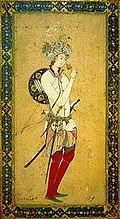
[March 24] Harun al-Rashid, Caliph of Sunni Islam

English Name: Aaron the Just
True Name: Hārūn ar-Rashīd (هارون الرشيد)
Parents:  Muhammad ibn Mansur al-Mahdi, Abbasid Caliph, and Al-Khayzuran bint Atta
Date of Birth: 17 March 763
House: Abbasid
Predecessor: Al-Hadi
Spouse: Zubaidah, daughter of Ja'far and Salsal
Reign: 786 – 809
Summary: Harun was the son of the third Abbasid Caliph and his wife, al-Khayzuran, a former slave girl from Yemen. During his early years, he received much of his education from his mother. The government at the time of his birth was under the control of the Barmakid clan, a Persian-Tajik family of ancient origins. Drama within his family, especially among his sister and the son of vizier Yahya, dominated much of his teenage years. He led a few campaigns against the Byzantine Empire in the 780s and reached as far west as the Dardanelles.

Harun became caliph upon the death of his father in 786. His son, al-Ma'mun was born the same day. Harun's reign led to the flourishing of Baghdad maintained by tribute paid to the Caliphate by the many vassal states. In 796, Harun moved the capital and government center to Ar Raqqah, north-west of Baghdad. He moved it probably for better communication, since its new location put it within earshot of Persia, Byzantium, Syria, and Egypt. Unfortunately, Harun's reign also saw the slow decline of the Caliphate. Umayyad rebels, those who followed the preceding dynasty, had taken over Syria and Spain, while other groups took over Morocco and Tunisia. Despite all this, Harun mostly focused on the Byzatines. He left actual control of the government to the Barmakids. To prepare his sons for government, he granted each of them half the empire. This would later lead to civil war between the two sons. Negotiations over Christian access to the Holy Land were made between Harun and Charlemagne, and this exchange may have sparked the Carolingian renaissance, but did little for the Caliphate and, indeed, may have helped focus Christian opposition to Islam in the centuries to come. It did introduce The Book of One Thousand and One (Arabian) Nights to Europe, which continues in popularity to this day and stars Harun as one of its characters. Harun also sent diplomats to China where good relations were established. During a campaign in Transoxania, in norther Iran, Harun became suddenly ill and died. The Abbasid Caliphate began a quick decline in power after his death, though the dynasty survive through his descendants into the mid-1450s when the Ottoman Empire assumed the title and the last caliph disappeared.
Date of Death: 24 March 809
Successor: Al-Amin

Other Monarchs Who Died Today:
  • Hugh III, king of Cyprus (1284)
  • Nicholas V, pope of Rome (1455)
  • Hosokawa Harumoto, Japanese daimyo (1563)
  • Elizabeth I, queen of England & Ireland (1603)

Friday, March 23, 2012

[March 23] Pedro, king of Castile

Surname: "The Cruel"
Parents:  Alfonso XI, king of Castile, and Maria of Portugal
Date of Birth: 30 August 1334
House: Burgundy
Predecessor: Alfonso XI
Spouse: Blanche, daughter of Peter I, duke of Bourbon, and Isabella of Valois, then Juana of Castro
Reign: 1350 – 1369
Summary: Pedro did not grow up cruel. He was a happy child who loved both work and play. He was a patron of the arts, including drama, poetry, and music. Still, he came to power at the age of sixteen and was controlled by his mother for the first two years of his reign. Pedro was betrothed to Joan, the daughter of King Edward III of England, but the princess died of the black death while on her way to the Castilian court.


The intrigues of Pedro stem primarily from his mother who was domineering and dangerous. Pedro eloped with his lover, María de Padilla, in 1353. Yet only months later, his mother forced him to marry Blanche of Bourbon, whom he deserted immediately. Pedro was forced to renounce his first marriage but produced four children with her. Both María and Blanche died in 1361 and Pedro relied on mistresses from that point forward. Throughout the late 1350s to mid-1360s, Pedro was engaged in the "War of the Two Peters" with Aragón. Castile was allied with England while Aragón was allied with France in this extension of the Hundred Years' War. All turned ill for Castile in the end. In 1366, civil war broke out within Castile and Pedro was deposed by his illegitimate brother, Enrique of Trastámara. Pedro did not fight but fled to the south of Spain. He finally settled in Portugal with his uncle, Pedro I, until he moved into Galicia. There he committed the atrocities for which he is famous; namely murdered in the archbishop of Santiago and the local dean. All the while, Enrique spread anti-Pedro propaganda across Castile, labeling him a Jewish-sympathizer and forcing the conversion of hundreds of Jews. Late in 1366, Edward the Black Prince of England helped restore Pedro to the throne. Edward almost turned on his ally but was forced to return to England due to ill health before he could act. Enrique returned in 1368 and gained the recognition of the Castilian cortes. Pedro finally confronted his brother in battle in March 1369. Pedro was tricked into leaving the safety of Montiel tower and was repeatedly stabbed in the face with a knife by Enrique. The king's body was left unburied for three days and was viciously abused. Two of Pedro's daughters by María, Constance and Isabella, married sons of King Edward III of England and the cause of Pedro was continued by his son-in-law, John of Gaunt, until the latter's death in 1399.
Date of Death: 23 March 1369
Successor: Enrique II

Other Monarchs Who Died Today:
  • Eudes I, duke of Burgundy (1103)
  • Julius III, pope of Rome (1555)
  • Gelawdewos, emperor of Ethiopia (1559)

Thursday, March 22, 2012

[March 22] George, king of Bohemia

True Name: Jiří z Poděbrad
Parents:  Victor of Kunštát and Poděbrady and Anna of Wartenberg
Date of Birth: 23 April 1402
House: Poděbrady
Predecessor: Ladislaus I Posthumous
Spouse: Kunigunde, daughter of Smil of Sternberg and Barbara of Pardubice, then Johana, daughter of John of Rožmitál and Ludmilla of Strakonicz
Reign: 1458 – 1471
Summary: George was born into a fighting family of moderate Hussites, a group of Czech Christian reformers that predate the Protestant Reformation. When he was fourteen, he participated in the Battle of Lipany which was a battle between radical Hussites and moderate Hussites allied with the Catholics. George's group won and George went on to become of the leaders of the Hussites, defeating Austrian troops a few years later. During the reign of King Ladislaus, Bohemia divided into Catholics and Hussites, with George leading the latter. In 1448, George raised an army and led it on campaign to Prague which he captured with little resistance. Civil war broke out across Bohemia and George eventually defeated the Catholics. Fearing further revolt, Holy Roman Emperor Frederick III made George regent of Bohemia in 1451 until Ladislaus came of age. But the war continued and was not aided by the young king who was raised a staunch Catholic. When Ladislaus was crowned king in 1453, things took a turn for the worst. Ladislaus died unexpectedly in 1457 and George took control of the government within a year, drawing support from the estates and, unexpectedly, the Catholics.

The first non-Habsburg ruler of Bohemia in a number of years, George had to face opposition not just from papal loyalists but from Austria as well. George ruled on the edge of a knife. To resolve all his problems, he suggested a Christian Union between the German states (including Bohemia), France, and the Italian states. It was the first of its kind since Roman times and a precursor to the European Union. He proposed expanding the union to include the Hispanic states in a few years. As a part of this union, he suggested that the leaders of each nation meet in parliament at times of strife and settle their differences through peace. He suggested a Christian union to suggest an alliance against the Turks who had conquered Constantinople a decade earlier. Unfortunately, Pope Pius II declined the offer of a union and continued to seek a crusade against the Hussites of Bohemia. When Pius died in 1464, Pope Paul II also declined. With no support coming from the Papacy, the Catholic party in Bohemia began to waver. Some made an alliance with the pope leading to the pope's excommunication of King George in 1466. The Holy Roman Empire and the King of Hungary joined with the pope against Bohemia. In 1468, Matthias of Hungary took over most of Moravia and was crowned king of Hungary in 1469. In 1470, King George and King Matthias came to terms despite recent successes against Hungary by Bohemia. George died the following year and the Hussites chose Vladislaus II, the son of the king of Poland, as the new leader of the Hussites despite George leaving multiple sons behind who could have inherited the throne.
Date of Death: 22 March 1471
Successor: Vladislaus II

Other Monarchs Who Died Today:
  • Constantine I, emperor of Rome (337)
  • George, king of Bohemia (1471)

Wednesday, March 21, 2012

[March 21] Robert I, duke of Burgundy

Surname: "The Old"
Parents: Robert II, king of the Franks, and Constance of Arles
Date of Birth: 1011
House: Capet
Predecessor: Henri I, king of the Franks
Spouse: Helie, daughter of Dalmace I, lord of Semur, then Ermengarde, daughter of Fulk III, duke of Anjou, and Hildegarde of Sundgau
Reign: 1032 – 1076
Summary: Robert was one of the many children of King Robert II and his wife Constance. Robert grew up in a house of little love, with his father constantly trying to annul his marriage to his wife to no avail. Robert's oldest brother, Hugues, was crowned co-king of the Franks in 1017. In 1025, Hugues, Robert, and their brother Henri began a rebellion against Robert II. Sometime in late 1025 or early 1026, Hugues died from a fall from his horse. Henri and Robert kept the rebellion going despite losing support from their mother, Constance. Constance did not help in the dispute. Once Hugues died, she supported the younger Robert as heir to the throne rather than the elder Henri. The brothers almost came to blows but King Robert II resolved the issue in 1027 when he crowned Henri co-king. For the next four years, Henri and Robert kept their father in a virtual prison within Paris until he died in 1031. In that year, King Henri I became king and prince Robert began a revolt of his own against his brother with the support of Constance. King Henri wisely resolved the issue by granting his brother the significant duchy of Burgundy in 1032, a domain which would remain in his descendant's hands for two centuries.

Less is known about Robert's rule as duke in Burgundy. From what is known, it seems he had little control over the regional lords. Robert was often forced to plunder his own lands for taxes and fees. Churches were an especially common target since they often lacked protection. The entire diocese of Autun was made into a private possession of the duke and Robert also seized the wine production center of Dijon. In 1055, Robert abandoned his wife and personally murdered her brother and father. His popularity was so low that one of his own bishops would not dedicate a church to him. After living such a long life, it is no surprise that Robert outlived his two eldest surviving children. His first son, Hugues, died at the age of fifteen in battle. His second son, Henri, lived to be 39 before dying. It is from Henri that Robert found his heir, Hugues I, when he died in 1076. A brother of that duke, Henri, became count of Portugal and his descendants in the male line ruled Portugal until 1853.
Date of Death: 21 March 1076
Successor: Hugues I

Other Monarchs Who Died Today:
  • Robert II, duke of Burgundy (1306)

Tuesday, March 20, 2012

[March 20] Hermann von Salza, Grand Master of the Teutonic Knights

Date of Birth: circa 1165
Predecessor: Heinrich von Tunna
Reign: 1210 – 1239
Summary: Hermann was probably one of the initial founding members of the Order of the Teutonic Knights, a chivalric order formed to serve against the Muslims in the Crusades. He probably first saw action at the Siege of Acre during his late teens. During the Crusade of 1197, Hermann was a witness to the coronation of Amalric II, king of Jerusalem. The Order was re-established in late 1197 under Heinrich Walpot von Bassenheim with the mission to secure Latin properties in the Holy Land. Hermann's role in these early years of the order are unknown, but he became Grand Master at the latest in 1210 when he served in the coronation of John of Brienne as king of Jerusalem.

Hermann was a long-time friend of Holy Roman Emperor Frederick II and served as Frederick's mediator in  the Papal curia from 1222 until his death. Conveniently, Hermann was also respected by Pope Honorius III who granted the Teutonic Knights equal status with the Knights Hospitaller and the Knights Templar. Hermann was a fighter of a grand master and led the Knights on a crusade in Transylvania to defend the native Hungarians and Romanians from the Cumans. But the Hungarian nobility were displeased with the Knights and the Order left in 1225. During this time, Hermann himself went with Frederick II on the Fifth Crusade and encouraged the undertaking of the Sixth Crusade a few years later. It was partially with Hermann's encouragement that Frederick married Yolanda of Brienne so that the emperor could later claim the Kingdom of Jerusalem. Upon his return, Konrad I, king of Masovia, requested the help of the Teutonic Knights to subdue the Old Prussians from Estonia. The Order agreed and moved north and began their campaign from 1230 onwards. In 1237, the Order expanded to include the Livonian Brothers of the Sword. The Knights grew tired of their oft-absentee Grand Master and recalled him in 1238, forcing him to retire. He died in 1239 at his estate at Salerno, Italy. Frederick II and the pope had a falling out within days.
Date of Death: 20 March 1239
Successor: Conrad of Thuringia

Other Monarchs Who Died Today:
  • Alexios III, emperor of Trebizond (1390)
  • Henry IV, king of England (1413)
  • Albert, duke of Prussia (1568)
  • Mathias, Holy Roman Emperor (1619)
  • Juliana, queen of the Netherlands (2004)

Labels

[brief] (102) female monarch (31) Capet (26) [abbreviated] (19) Roman Empire (17) Great monarchs (16) Japan (15) Papacy (15) England (13) saints (13) France (11) Portugal (11) [Missing Deaths] (11) Habsburg (10) Sweden (10) Byzantine Empire (9) Carolingian (9) China (9) Hohenzollern (9) Oldenburg (9) Holy Roman Empire (8) Japan (dynasty) (8) Aragón (7) Austria (7) Denmark (7) Electorate (7) Ethiopia (7) Hungary (7) Navarre (7) Norway (7) Romanov (7) Russia (7) Saxony (7) Scotland (7) Wettin (7) Wittelsbach (7) Bavaria (6) Burgundy (6) Egypt (6) Italy (6) Lorraine (6) Luxembourg (6) Persia (6) Poland (6) Sicily (6) Spain (6) Valois (6) Capet-Burgundy (5) Franks (5) Germany (5) Plantagenet (5) Prussia (5) Quraish (5) Solomon (Ethiopia) (5) Tuscany (5) Anjou (4) Aquitaine (4) Barcelona (dynasty) (4) Bohemia (4) Brittany (4) Burgundy-Aviz (4) Burma (4) Capet-Valois (4) Castile (4) Constantinople (Patriarchate) (4) Habsburg-Lorraine (4) Holstein-Gottorp-Romanov (4) India (4) Ireland (4) Jerusalem (4) Jiménez (4) Kiev (4) Mongolia (4) Naples (4) Netherlands (4) Normandy (4) Osman (4) Ottoman (4) Palaeologos (4) Savoy (4) Savoy (dynasty) (4) Trastámara (4) Wales (4) Afghanistan (3) Albania (3) Bagrationi (3) Banu Hashim (3) Blois (3) Borjigin (3) Bourbon (3) Brabant-Hesse (3) Brandenburg (3) Capet-Bourbon (3) Cologne (3) Croatia (3) Cyprus (3) Disney (3) Fairhair (3) Georgia (3) Gwynedd (3) Hainaut (3) Hesse (3) Hohenstaufen (3) Holland (3) Holstein-Gottorp (3) Inca (3) Islam (3) León (3) Limburg (3) Lithuania (3) Livonia (3) Lothier (3) Macedonia (dynasty) (3) Mainz (3) Mann (3) Medici (3) Morocco (3) México (3) Nassau (3) Nguyễn (3) Serbia (3) Stuart (Stewart) (3) Toungoo (3) Tudor (3) Turkey (3) Vaudemont (3) Vietnam (3) Welf (3) Wessex (3) published articles (3) Abberfraw (2) Aberffraw (2) Alexandria (patriarchate) (2) Angevins (2) Anglo-Saxon (2) Ardennes-Metz (2) Auvergne (2) Ayyubid (2) Basarab (2) Bernadotte (2) Billung (2) Boulogne (2) Brabant (2) Bruce (2) Burgundy-Bragança (2) Caliphate (2) Cilicia (2) Constantine (2) Crovan (2) Denmark (Dynasty) (2) Draculesti (2) Dreux (2) Dunkeld (2) Dutch Republic (2) Estridsen (2) Flanders (2) Florence (2) Further Austria (2) Greece (2) Habsburg-Spain (2) Hanover (2) Hardrada (2) Hauteville (2) Hawai'i (2) Ivrea (2) Joseon (2) Karadordevic (2) Konbaung (2) Korea (2) Maya (2) Merovingian (2) Milan (2) Ming (2) Monaco (2) Nassau-Orange (2) Nassau-Weilburg (2) Norman (2) Novgorod (2) Orange (2) Ottonian (2) Piast (2) Piedmont-Savoy (2) Poitiers (dynasty) (2) Robertian (2) Romania (2) Rurik (2) Sardinia (2) Saxe-Coburg-Gotha (2) Seljuk (2) Siam (2) Syria (2) Teutonic Knights (2) Thailand (2) Theodosian (2) Thuringia (2) Timurid (2) Tokugawa (2) United Kingdom (2) Valois-Burgundy (2) Vandal (2) Venice (2) Visconti (2) Vladimir (2) Wallachia (2) Württemberg (2) York (2) Yugoslavia (2) Zeeland (2) the Britons (2) 18th Dynasty (Egypt) (1) Abbasid (1) Adal (1) Agiad (1) Akinyele (1) Al Khalifa (1) Al-Said (1) Alawiyya (Egyptian) (1) Albret (1) Algeria (1) Algonquian (1) Amber (1) Angola (1) Anjou (dynasty) (1) Anjou-Hungary (1) Ansbach (1) Antonia (1) Antonine (1) Apulia (1) Arabia (1) Armenia (1) Arpad (1) Arsacid (1) Asen (1) Ashikaga (1) Athens (1) Avesnes (1) Avignon Papacy (1) Aviz-Beja (1) Aztec Empire (1) Baden (1) Bahrain (1) Balti (1) Barakzai (1) Barazkai (1) Barcelona (1) Battenberg (1) Belgium (1) Bengal (1) Berg (1) Berg (dynasty) (1) Bernicia (1) Bharatpur (1) Bhutan (1) Bjelbo (1) Bonaparte (1) Bonde (1) Bonngau (dynasty) (1) Borghese (1) Borja (1) Bosnia (1) Bourbon-Two Sicilies (1) Brandenburg-Ansbach (1) Brienne (1) Brutus (1) Bukhara (1) Bulgaria (1) Canossa (1) Capet-Dreux (1) Carthage (1) Celje (1) Celje (dynasty) (1) Chakri (1) Champagne (1) Champagne (dynasty) (1) Chartres (1) Cometopuli (1) Contantine (1) Cordoba (1) Craiovesti (1) Crusader States (1) Dalmatia (1) Damascus (1) Danesti (1) Debeubarth (1) Deira (1) Deira (dynasty) (1) Denmar (1) Dulo (1) Díaz (1) Early Han (1) East Anglia (1) East Francia (1) Eastern Han (1) Eastern Jin (1) Egmont (1) Estonia (1) Farnese (1) Fatimid (1) Fatimid Caliphate (1) Flanders (dynasty) (1) Flavian (1) Friuli (1) Gausi (1) Geneva (1) Geneva (dynasty) (1) Gordiani (1) Grimaldi (1) Guelders (1) Guideschi (1) Gwent (1) Gwynedd (dynasty) (1) Gyatso (1) Haag (1) Hainaut (dynasty) (1) Hanan Cuzco (1) Hashim (1) Hashimite (1) Hebrides (The Isles) (1) Hellenes (1) Herat (1) Hohenzollern-Ansbach (1) Hohenzollern-Sigmaringen (1) Holland (dynasty) (1) Hunfriding (1) Ibadan (1) Iran (1) Iturbide (1) Jaipur (1) Jin (1) Jordan (1) Julio-Claudian (1) Jungingen (1) Justinian (dynasty) (1) Kachwaha (1) Kalakaua (1) Kamehameha (1) Karrani (1) Kent (1) Kent (house) (1) Kestutis (1) Khurasan (1) Knights Templar (1) Komnenos (1) Kotromanić (1) Lakota Sioux (1) Lancaster (1) Latin Empire (1) Lebanon (1) Leuchtenberg (1) Lombards (1) Ludowinger (1) Lusignan (1) Luxembourg (dynasty) (1) Luxembourg-Limburg (1) Maan (1) Macedon (1) Magdeburg (1) Maine (1) Majorca (1) Malaysia (1) Manghit (1) Maratha Empire (1) Marinid (1) Matsunaga (1) Maurya (1) Mecklenburg (1) Mecklenburg-Strelitz (1) Meissen (1) Mercia (1) Mercia (dynasty) (1) Miniconjou (1) Moldavia (1) Montenegro (1) Montferrat (1) Morgannwg (1) Mortain (1) Mountbatten (1) Mughal (1) Muhammad Ali (1) Munster (1) Musat (1) Myanmar (1) Nakagawa (1) Ndongo and Matana (1) Nemanjic (1) Nepal (1) Nervo-Trajan (1) Neuchâtel (1) Nigeria (1) Nominoë (1) Northumbria (1) O'Brien (1) Obrenović (1) Odowa (1) Olgovich (1) Olympus (1) Orléans-Longueville (1) Ostrogoths (1) Ottawa (1) Pahlavi (1) Palatinate of the Rhine (1) Parma (1) Penthièvre (1) Petrović-Njegoš (1) Poděbrady (1) Pointiers (Ramnulfids) (1) Poitiers (1) Poitiers-Lusignan (1) Polignac (1) Powys (1) Prasat Thong (1) Premyslid (1) Provence (1) Přemyslid (1) Q'umarkaj (1) Qin (1) Qing (Manchu) (1) Reginar (1) Reginarid (1) Rethel (1) Rethel-Boulogne (1) Ribagorza (1) Rouergue (1) Roupenians (1) Sa Malietoa (1) Safavid (1) Salian (1) Salzburg (1) Samoa (1) Sarantapechos (1) Saud (1) Saudi Arabia (1) Second Triumvirate of Rome (1) Selangor (1) Selangor (dynasty) (1) Sforza (1) Shah (Nepal) (1) Shi'a Imamate (1) Shishman (1) Shivaji (1) Silesia (1) Simmern (1) Sinsinwar Jat (1) Skowronski (1) Slovenia (1) Sobieski (1) South Africa (1) South America (1) Sparta (1) Spoleto (1) Sture (1) Sudan (1) Sussex (1) Sverre (1) Swabia (1) Swasi (dynasty) (1) Swaziland (1) Swiss Confederation (1) Tang (1) Tenochtitlan (1) Teotihuacán (1) Terter (1) Tibet (1) Tikal (1) Tolkien (1) Toulouse (1) Tours (dynasty) (1) Transylvania (1) Tunisia (1) Umayyad (1) Unruoching (1) Valencia (1) Valois-Angoulême (1) Valois-Anjou (1) Valois-Orléans (1) Vasa (1) Vermandois (1) Visigoths (1) Vokil (1) Wangchuck (1) Wied-Neuwied (1) Windsor-Mountbatten (1) Württemberg (dynasty) (1) Yamato (1) Ying (Qin) (1) Yuan (1) Zanzibar (1) Zhao (Song) (1) Zhou (1) Zhu (1) Zogu (1) Zulu Nation (1) Zápolya (1) Zähringen (1) bretwalda (1) cardinal (1) fantasy (1) fiction (1) shogunate (1) terms (1) Árpád (1) Öuchi (1)