Friday, February 17, 2012

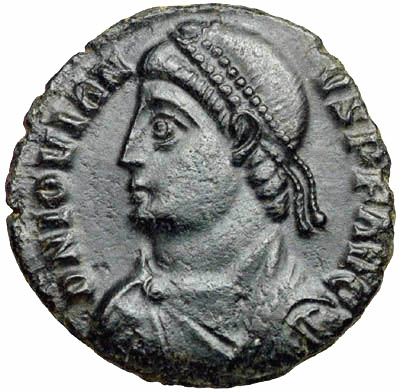
[February 17] Jovian, emperor of Rome

True Name: Flavius Jovianus
Parents: Flavius Varronianus
Date of Birth: 331
Spouse: Charito, daughter of Lucillianus
Reign: 363  – 364
Predecessor: Julian
Summary: Flavius Jovianus was the last of the breed of Constantine, though he was not a member of the family. He was born near modern-day Belgrade, Serbia, the son of a commander in Constantius II's bodyguard. He himself joined the guards and had risen to the same rank by the time of his elevation to emperor. He accompanied Emperor Julian on his campaigns against Emperor Shapur II of Persia but the army was forced to retreat and Julian was mortally wounded. Saturninius Secundas Salutius, a praetorian prefect of Asia, was nominated to replace the emperor, but he declined. Jovian was the next logical choice. There is a high likelihood that Jovian was never meant to be emperor. When his name was put forward, it is highly possible that the army misheard the name and either thought that a different Jovian was being referred to or that Julian had recovered. In any case, Jovian became emperor by popular acclamation on 27 June 363.

Julian was often known as "the Apostate" because he had turned away from the Christian faith. Jovian returned Rome to Christianity. He revoked edicts condemning Christians and restored the Chi-Rho Labarum of Constantine I. Yet Jovian went further. He ordered the pagan Library of Antioch to be burned to the ground and made the worshipping of ancestral gods a capital crime. By the end of the year, even participating in a pagan ceremony could earn the death penalty. His intolerance of non-Christians became standard from his reign all the way to the nineteenth century. Julian was the last non-Christian emperor of Rome and Jovian established what became the standard Christian realm that all other kingdoms were held up to. And while not all of Europe was Christianized by 364, other non-Christian religions were in decline. Meanwhile, Jovian had to make a hasty retreat from Sassanid Persia, ceding five large provinces to Persia as well as the protection of the Kingdom of Armenia. Such a retreat lost Jovian all of his popularity. He rushed to Constantinople from Antioch to consolidate his power, but it was too late already. Luckily for Jovian, he died probably by accident during his flight. He was found dead, only eight months into his reign, due to bad mushrooms or CO2 poisoning from a charcoal fire.
Date of Death: 17 February 364
Successor: Valentinian I

Other Monarchs Who Died Today:
  • Otto, duke of Austria (1339)
  • Ivan Alexander, tsar of Bulgaria (1371)
  • Ferdinando I, grand duke of Tuscany (1609)
  • Albert I, king of Belgium (1934)

Thursday, February 16, 2012

[February 16] Henry Raspe, landgrave of Thuringia

Parents: Hermann I, landgrave of Thuringia, and Sophia of Bavaria
Date of Birth: 1204
Royal House: Ludowinger
Spouse: 
Reign: 1241 – 1247
Predecessor: Hermann II
Summary: Henry Raspe led an interesting life. He was catapulted into leadership of Thuringia, a large area in the center of Germany, by the unexpected death of his brother, Louis IV, while he was en route to the Sixth Crusade in 1226. Louis left a son, Hermann II, as his heir and Henry became his nephew's regent. Having no desire to babysit a four-year-old, Henry actively worked to depose his nephew and be elected landgrave officially. His plans mostly came to fruition in 1231 when he expelled the boy's mother, Elisabeth of Hungary, from the country. She died soon after. Without a protector, Hermann became a tool through which Henry Raspe claimed the landgraviate. Hermann lived as titular landgrave for another ten years, finally dying in 1241, probably due to poison since he had just come of age the previous year.


Henry, as a prominent German ruler, was selected in 1242 in tandem with King Wenceslaus I of Bohemia to act as caretakers for Emperor Frederick II's son, Conrad. Henry did so loyally for three years until Frederick was excommunicated in 1245. At that time, Henry sought the Imperial crown from the technically deposed emperor. On 22 May 1246, Henry Raspe, with the support of Pope Innocent IV, was elected anti-king of Germany in opposition to both Frederick II and Conrad. Conrad revolted and was defeated at the Battle of Nidda in August of that year. Unfortunately, Henry faired little better and died early the next year at his Wartburg Castle in Thuringia. His childless and heirless death prompted the War of the Thuringian Succession which saw Thuringia fall to the House of Wettin and Hesse, a former dependency, be created as a new landgraviate. Henry's successor as anti-king was William II, count of Holland and Zeeland.
Date of Death: 16 February 1247
Successor: Henry III


Other Monarchs Who Died Today:
  • Afonso III, king of Portugal (1279)
  • John V, emperor of Constantinople (1391)

Wednesday, February 15, 2012

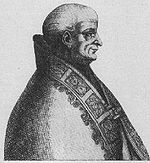
[February 15] Lucius II, pope of Rome

True Name: Gherardo Caccianemici dal Orso
Parents: Orso Caccianemici
Reign: 1144 – 1145
Predecessor: Celestine II
Summary: As with many popes, Gherardo began his life as a canon at the Basilica di San Frediano and then became a cardinal at Santa Croce in 1124. Both of these establishments he remembered in his year as pope because he gave them great gold and silver gifts for their collections. In 1125, Pope Honorius II made him the librarian of Rome and then papal legate to Germany. This rapid-fire succession of positions made his place in the papal hierarchy very apparent. His help in securing the Holy Roman Imperial throne for Lothair III made him famous, and for two years starting in 1128, he virtually controlled the city of Benevento for the Papacy. In 1130, Gherardo was again sent to Germany, this time to request Imperial aide in repelling Antipope Anacletus II. From this time forward, Gherardo was the chief diplomat to Germany, which awarded him the position of papal chancellor, a coveted position that often led to the papacy. And so it did for Gherardo, who was elected as Lucius II on 12 March 1144.


For only serving as pope for a eleven months, Lucius was an eager and successful pope. He reorganized much of the church in England and took the side of Matilda versus Stephen in the Anarchy. He took control of the town of Lucca in Italy then returned it to the people as the town's protector. In Portugal, Afonso I, the first recognized king of the country, sought independence from León via Lucius. Lucius declined the title of king, but accepted its independence and granted him the title of Duke of Portugal. Conflict with Sicily forced Lucius to make an uneven peace with King Roger II. In exchange for a cessation of hostilities, Sicily was granted additional lands. This angered the Roman Senate and they revolted against the Papacy, declaring the Roman Commune. The group demanded that Lucius abandon all government duties in Rome and stick to the ecclesiastical duties. Rome became a battleground, with camps set up across the Roman ruins of the old Forum and Circus Maximus. On the Ides of February, Lucius led a small army against the Senatorial army and was defeated, being injured by a thrown stone in the process. He did not recover and died soon after. His successor, Eugene III, was unable to rule from Rome for most of his reign due to the Commune.
Date of Death: 15 February 1145
Successor: Eugene III


Other Monarchs Who Died Today:
  • Ferdinand II, Holy Roman Emperor (1637)

Tuesday, February 14, 2012

[February 14] Ragnvald Godredsson, king of the Isles

True Name: Rögnvaldr Guðrøðarson
Parents: Guðrøðr Óláfsson, king of the Isles, and Sadb
Royal House: Crovan
Reign: 1187 – 1226
Predecessor: Godred II
Summary: Ragnvald was one of the greatest kings who ever ruled the Isles and Man west of mainland Scotland. The Crovan family were descended from Norse vikings who conquered eastern Ireland and north-west Scotland in the 11th century. Ragnvald was probably the eldest son of Godred but Olaf was the eldest legitimate son and was the one chosen to succeed to the throne. Yet Olaf was only a child and Ragnvald was chosen by the Manx aristocracy to rule regardless. Olaf was given the isle of Lewis, an impoverished rock off the Scottish coast. Olaf later petitioned for Ragnavald to grant him more lands, and the king sent him to William I of Scotland to have him imprisoned, where Olaf remained until around 1214.


Meanwhile, Ragnvald maintained good relations with King William I of Scots. He assisted the king in pacifying multiple revolts and eventually occupied the region of Caithness for the Scottish king, buying it outright after two rounds of negotiations. In Wales, he forged marriage alliances between his daughters with the Welsh kings and lords. In Ireland, he drew soldiers to support his armies as they aided the Scots. The problem with the Kingdom of the Isles was its vastness. Stretching from northern Scotland down to Mann off the Lancastrian coast, it was hard to defend. And so King John, in 1210, likely invaded Mann while Ragnvald was away in another part of his realm. It is highly possible that this raid was approved since John had political rivals on the island, but in either case, it shows the relative defenselessness of the island in the Irish Sea. Traditionally, though, the Crovans were allies with the kings of Norway, their ancient forefathers. and for a hundred years they had not paid their tribute to the kingdom. Norway raided the kingdom in the 1210s, but Norway was trapped in a civil war so both sides, claiming legitimacy, raided for their own gain. Ragnvald fled to the English crown to ask for aid, but it came at a steep cost. The Isles became, in effect, an English dependency. Tribute was paid in return for protection. At the same time, Ragnvald paid homage to the Papacy, in return being accepted as the legitimate king of the Isles against the claims of Olaf, who had recently been released. Relations between the brothers were estranged and Ragnvald's son, Godred, went by order of his mother to finish Olaf once and for all. An invasion by Godred caused Olaf to flee for the mainland, but Olaf returned soon after with a superior force and they captured, blinded, and castrated Godred. Olaf then landed on Mann itself to resolve the kin strife. The kingdom was divided, with Ragnvald ruling Mann as king and Olaf ruling the Isles as heir-apparent. Ragnvald attempted to retake the islands from his brother but failed, partially because his own soldiers were unwilling to fight their kinfolk. Ragnvald fled to Galloway to enlist the aid of the local lord through a marriage alliance, but the prospect of a future Manx king coming from Galloway caused the nobles of Mann to depose Ragnvald outright, replacing the king with Olaf. Three years later, Ragnvald invaded Mann with a small force and met his brother at Tynwald. He was slain in battle, possibly as the result of deception, and he was buried at St. Mary's Abbey in Furness.
Date of Death: 14 February 1229
Successor: Olaf

Other Monarchs Who Died Today:
  • Richard II, king of England (1400)
  • Singu Min, king of Burma (1782)

Monday, February 13, 2012

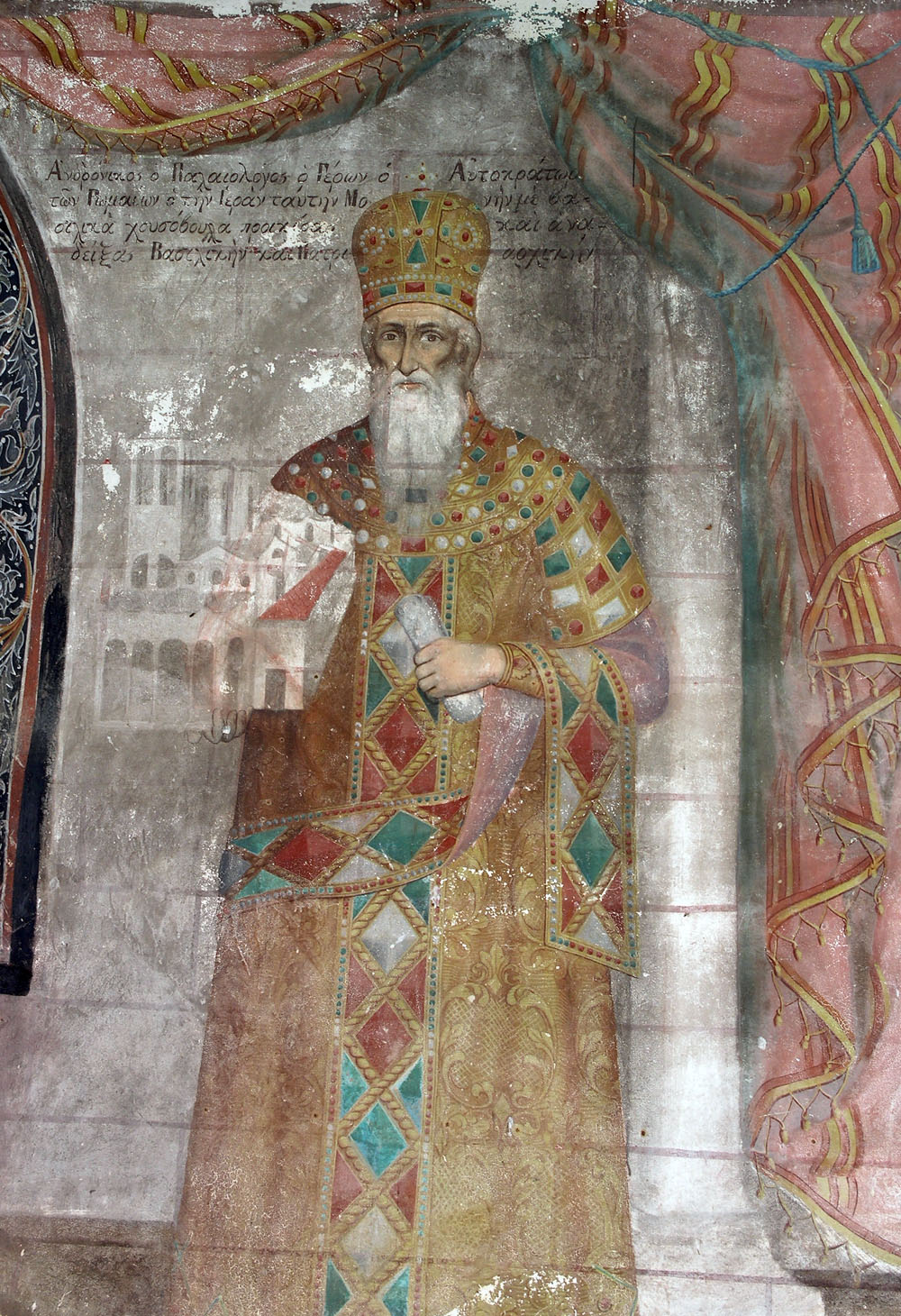
[February 13] Andronikos II, emperor of Constantinople

True Name: Ανδρόνικος Β' Παλαιολόγος
Parents: Michael VIII, Byzantine Emperor, and Theodora Doukaina Vatatzina
Date of Birth: 25 March 1259
Royal House: Palaiologos
Spouse: Anna, daughter of King Stephen V of Hungary, then Yolande, daughter of Marquess William VII of Montferrat
Reign: 1272 – 1328
Predecessor: Michael VIII
Summary: Andronikos was crowned co-emperor of Constantinople at the age of two after his father, Michael VIII, recovered the empire from the Latin Crusaders who had sacked and conquered it eighty years earlier. He was born in Nicaea where the family was established prior to the reconquest. His reign, beginning in 1282, was a troubled one from the start. Problems with the Catholic and Orthodox church from the occupation made him unpopular with both. Meanwhile. the empire was broke and in debt, having only a seventh the revenue of the pre-conquest state. Andronikos raised taxes and dissolved the Byzantine navy, making the state increasingly dependent on the maritime Venetian and Genoan republics. Later attempts to rebuild the navy failed.

As a diplomat, Andronikos did everything right yet still got little in return. He married Yolande, heiress of Montferrat, in an effort to consolidate the claims of her family on the Kingdom of Thessalonica, a state formed during the Latin occupation. Furthermore, he attempted to marry his son and co-emperor, Michael IX, to the Latin Empire heiress, Catherine of Courtenay, thereby ending the Latin claim on the Byzantine throne, but the marriage attempt fell through. But no amount of diplomacy could stop the swell of Islamic fervor in Asia Minor. Andronikos purchased the help of the Catalan Company, a group of Hispanic mercenaries, but they failed to retake Asia Minor and eventually turned on the Byzantine Empire and sacked northern Greece before fleeing to the southern Latin states. The Ottoman Empire was on the rise, being led by its namesake, Osman I, as it slowly took over modern-day Turkey. Other nomadic Turkic groups were also moving into Byzantine possessions in the Near East. In the Balkans, beside the raids of the Catalan Company, Bulgaria was asserting its independence and it was only resolved by another marriage alliance. Michael's IX son, Andronikos, began a civil war for the throne and allied with the Bulgarians who were led by his brother-in-law. In 1328, Andronikos entered Constantinople and deposed his grandfather, forcing him to live out his remaining four years as a monk. 
Date of Death: 13 February 1332
Successor: Andronikos III


Other Monarchs Who Died Today:
  • Kenneth I, king of Scots (858)
  • Honorius II, pope of Rome (1130)
  • Béla II, king of Hungary (1141)
  • Stefan Nemanja, grand prince of Serbia (1199)
  • Minamoto no Sanetomo, shogun of Japan (1219)
  • Isabella, marquise of Mantua (1539)
  • Charles X, king of Sweden (1660)

Labels

[brief] (102) female monarch (31) Capet (26) [abbreviated] (19) Roman Empire (17) Great monarchs (16) Japan (15) Papacy (15) England (13) saints (13) France (11) Portugal (11) [Missing Deaths] (11) Habsburg (10) Sweden (10) Byzantine Empire (9) Carolingian (9) China (9) Hohenzollern (9) Oldenburg (9) Holy Roman Empire (8) Japan (dynasty) (8) Aragón (7) Austria (7) Denmark (7) Electorate (7) Ethiopia (7) Hungary (7) Navarre (7) Norway (7) Romanov (7) Russia (7) Saxony (7) Scotland (7) Wettin (7) Wittelsbach (7) Bavaria (6) Burgundy (6) Egypt (6) Italy (6) Lorraine (6) Luxembourg (6) Persia (6) Poland (6) Sicily (6) Spain (6) Valois (6) Capet-Burgundy (5) Franks (5) Germany (5) Plantagenet (5) Prussia (5) Quraish (5) Solomon (Ethiopia) (5) Tuscany (5) Anjou (4) Aquitaine (4) Barcelona (dynasty) (4) Bohemia (4) Brittany (4) Burgundy-Aviz (4) Burma (4) Capet-Valois (4) Castile (4) Constantinople (Patriarchate) (4) Habsburg-Lorraine (4) Holstein-Gottorp-Romanov (4) India (4) Ireland (4) Jerusalem (4) Jiménez (4) Kiev (4) Mongolia (4) Naples (4) Netherlands (4) Normandy (4) Osman (4) Ottoman (4) Palaeologos (4) Savoy (4) Savoy (dynasty) (4) Trastámara (4) Wales (4) Afghanistan (3) Albania (3) Bagrationi (3) Banu Hashim (3) Blois (3) Borjigin (3) Bourbon (3) Brabant-Hesse (3) Brandenburg (3) Capet-Bourbon (3) Cologne (3) Croatia (3) Cyprus (3) Disney (3) Fairhair (3) Georgia (3) Gwynedd (3) Hainaut (3) Hesse (3) Hohenstaufen (3) Holland (3) Holstein-Gottorp (3) Inca (3) Islam (3) León (3) Limburg (3) Lithuania (3) Livonia (3) Lothier (3) Macedonia (dynasty) (3) Mainz (3) Mann (3) Medici (3) Morocco (3) México (3) Nassau (3) Nguyễn (3) Serbia (3) Stuart (Stewart) (3) Toungoo (3) Tudor (3) Turkey (3) Vaudemont (3) Vietnam (3) Welf (3) Wessex (3) published articles (3) Abberfraw (2) Aberffraw (2) Alexandria (patriarchate) (2) Angevins (2) Anglo-Saxon (2) Ardennes-Metz (2) Auvergne (2) Ayyubid (2) Basarab (2) Bernadotte (2) Billung (2) Boulogne (2) Brabant (2) Bruce (2) Burgundy-Bragança (2) Caliphate (2) Cilicia (2) Constantine (2) Crovan (2) Denmark (Dynasty) (2) Draculesti (2) Dreux (2) Dunkeld (2) Dutch Republic (2) Estridsen (2) Flanders (2) Florence (2) Further Austria (2) Greece (2) Habsburg-Spain (2) Hanover (2) Hardrada (2) Hauteville (2) Hawai'i (2) Ivrea (2) Joseon (2) Karadordevic (2) Konbaung (2) Korea (2) Maya (2) Merovingian (2) Milan (2) Ming (2) Monaco (2) Nassau-Orange (2) Nassau-Weilburg (2) Norman (2) Novgorod (2) Orange (2) Ottonian (2) Piast (2) Piedmont-Savoy (2) Poitiers (dynasty) (2) Robertian (2) Romania (2) Rurik (2) Sardinia (2) Saxe-Coburg-Gotha (2) Seljuk (2) Siam (2) Syria (2) Teutonic Knights (2) Thailand (2) Theodosian (2) Thuringia (2) Timurid (2) Tokugawa (2) United Kingdom (2) Valois-Burgundy (2) Vandal (2) Venice (2) Visconti (2) Vladimir (2) Wallachia (2) Württemberg (2) York (2) Yugoslavia (2) Zeeland (2) the Britons (2) 18th Dynasty (Egypt) (1) Abbasid (1) Adal (1) Agiad (1) Akinyele (1) Al Khalifa (1) Al-Said (1) Alawiyya (Egyptian) (1) Albret (1) Algeria (1) Algonquian (1) Amber (1) Angola (1) Anjou (dynasty) (1) Anjou-Hungary (1) Ansbach (1) Antonia (1) Antonine (1) Apulia (1) Arabia (1) Armenia (1) Arpad (1) Arsacid (1) Asen (1) Ashikaga (1) Athens (1) Avesnes (1) Avignon Papacy (1) Aviz-Beja (1) Aztec Empire (1) Baden (1) Bahrain (1) Balti (1) Barakzai (1) Barazkai (1) Barcelona (1) Battenberg (1) Belgium (1) Bengal (1) Berg (1) Berg (dynasty) (1) Bernicia (1) Bharatpur (1) Bhutan (1) Bjelbo (1) Bonaparte (1) Bonde (1) Bonngau (dynasty) (1) Borghese (1) Borja (1) Bosnia (1) Bourbon-Two Sicilies (1) Brandenburg-Ansbach (1) Brienne (1) Brutus (1) Bukhara (1) Bulgaria (1) Canossa (1) Capet-Dreux (1) Carthage (1) Celje (1) Celje (dynasty) (1) Chakri (1) Champagne (1) Champagne (dynasty) (1) Chartres (1) Cometopuli (1) Contantine (1) Cordoba (1) Craiovesti (1) Crusader States (1) Dalmatia (1) Damascus (1) Danesti (1) Debeubarth (1) Deira (1) Deira (dynasty) (1) Denmar (1) Dulo (1) Díaz (1) Early Han (1) East Anglia (1) East Francia (1) Eastern Han (1) Eastern Jin (1) Egmont (1) Estonia (1) Farnese (1) Fatimid (1) Fatimid Caliphate (1) Flanders (dynasty) (1) Flavian (1) Friuli (1) Gausi (1) Geneva (1) Geneva (dynasty) (1) Gordiani (1) Grimaldi (1) Guelders (1) Guideschi (1) Gwent (1) Gwynedd (dynasty) (1) Gyatso (1) Haag (1) Hainaut (dynasty) (1) Hanan Cuzco (1) Hashim (1) Hashimite (1) Hebrides (The Isles) (1) Hellenes (1) Herat (1) Hohenzollern-Ansbach (1) Hohenzollern-Sigmaringen (1) Holland (dynasty) (1) Hunfriding (1) Ibadan (1) Iran (1) Iturbide (1) Jaipur (1) Jin (1) Jordan (1) Julio-Claudian (1) Jungingen (1) Justinian (dynasty) (1) Kachwaha (1) Kalakaua (1) Kamehameha (1) Karrani (1) Kent (1) Kent (house) (1) Kestutis (1) Khurasan (1) Knights Templar (1) Komnenos (1) Kotromanić (1) Lakota Sioux (1) Lancaster (1) Latin Empire (1) Lebanon (1) Leuchtenberg (1) Lombards (1) Ludowinger (1) Lusignan (1) Luxembourg (dynasty) (1) Luxembourg-Limburg (1) Maan (1) Macedon (1) Magdeburg (1) Maine (1) Majorca (1) Malaysia (1) Manghit (1) Maratha Empire (1) Marinid (1) Matsunaga (1) Maurya (1) Mecklenburg (1) Mecklenburg-Strelitz (1) Meissen (1) Mercia (1) Mercia (dynasty) (1) Miniconjou (1) Moldavia (1) Montenegro (1) Montferrat (1) Morgannwg (1) Mortain (1) Mountbatten (1) Mughal (1) Muhammad Ali (1) Munster (1) Musat (1) Myanmar (1) Nakagawa (1) Ndongo and Matana (1) Nemanjic (1) Nepal (1) Nervo-Trajan (1) Neuchâtel (1) Nigeria (1) Nominoë (1) Northumbria (1) O'Brien (1) Obrenović (1) Odowa (1) Olgovich (1) Olympus (1) Orléans-Longueville (1) Ostrogoths (1) Ottawa (1) Pahlavi (1) Palatinate of the Rhine (1) Parma (1) Penthièvre (1) Petrović-Njegoš (1) Poděbrady (1) Pointiers (Ramnulfids) (1) Poitiers (1) Poitiers-Lusignan (1) Polignac (1) Powys (1) Prasat Thong (1) Premyslid (1) Provence (1) Přemyslid (1) Q'umarkaj (1) Qin (1) Qing (Manchu) (1) Reginar (1) Reginarid (1) Rethel (1) Rethel-Boulogne (1) Ribagorza (1) Rouergue (1) Roupenians (1) Sa Malietoa (1) Safavid (1) Salian (1) Salzburg (1) Samoa (1) Sarantapechos (1) Saud (1) Saudi Arabia (1) Second Triumvirate of Rome (1) Selangor (1) Selangor (dynasty) (1) Sforza (1) Shah (Nepal) (1) Shi'a Imamate (1) Shishman (1) Shivaji (1) Silesia (1) Simmern (1) Sinsinwar Jat (1) Skowronski (1) Slovenia (1) Sobieski (1) South Africa (1) South America (1) Sparta (1) Spoleto (1) Sture (1) Sudan (1) Sussex (1) Sverre (1) Swabia (1) Swasi (dynasty) (1) Swaziland (1) Swiss Confederation (1) Tang (1) Tenochtitlan (1) Teotihuacán (1) Terter (1) Tibet (1) Tikal (1) Tolkien (1) Toulouse (1) Tours (dynasty) (1) Transylvania (1) Tunisia (1) Umayyad (1) Unruoching (1) Valencia (1) Valois-Angoulême (1) Valois-Anjou (1) Valois-Orléans (1) Vasa (1) Vermandois (1) Visigoths (1) Vokil (1) Wangchuck (1) Wied-Neuwied (1) Windsor-Mountbatten (1) Württemberg (dynasty) (1) Yamato (1) Ying (Qin) (1) Yuan (1) Zanzibar (1) Zhao (Song) (1) Zhou (1) Zhu (1) Zogu (1) Zulu Nation (1) Zápolya (1) Zähringen (1) bretwalda (1) cardinal (1) fantasy (1) fiction (1) shogunate (1) terms (1) Árpád (1) Öuchi (1)