Monday, January 23, 2012

[January 23] Ya'qub al-Mansur, emir of Morocco

True Name: Abū Yūsuf Ya‘qūb al-Manṣūr (بو يوسف يعقوب المنصو)
Parents: Abu Ya'qub Yusuf, emir of Morocco
Date of Birth: c. 1160
Royal House: Almohad
Reign: 1184 – 1199
Predecessor: Abu Ya'qub Yusuf
Summary: Al-Manṣūr led a short life of continuous warfare. From the time that he ascended the throne in 1184, he vowed vengeance against the Christian crusaders who killed his father. But he first had to deal with the recently-ousted rival dynasty, the Almoravids. He finally defeated them and invaded the Iberian Peninsula. He had a great military conquest but returned home with many slaves. A full Christian uprising happened in his wake. Al-Manṣūr returned and defeated the Christians again, taking many more slaves than the first time and selling them to sub-Saharan traders. 

Morocco and the Almohad territories thrived during al-Manṣūr's reign. Architecture, science, and philosophy reached new heights in continental Europe, but it was to be short-lived. In July 1195, al-Manṣūr defeated the Castilian king Alfonso VIII at the Battle of Alarcos and sent the Castilians into a hard retreat to Toledo. Al-Manṣūr took up residence in Seville and continued to raid southern Iberia for the next four years. He took the title "al-Manṣūr Billah" which means "Made victorious by God". In 1198, al-Manṣūr finally lost interest in Iberia since he had reconquered most of the original Umayyad lands of four hundred years previous. He returned to Morocco and died a few months later. His empire crumbled under the reign of his son in 1212 at the Battle of Las Nevas de Tolosa, and the Muslim presence in Iberia began a permanent decline.
Date of Death: 23 January 1199
Successor: Muhammad an-Nasir, amir of Morocco

Other Monarchs Who Died Today:
  • Otto III, Holy Roman Emperor (1002)
  • Jiajing, emperor of China (1567)

Sunday, January 22, 2012

[January 22] Victoria, queen of the United Kingdom

True Name: Alexandrina Victoria
Parents: Edward, duke of Kent, and Victoria of Saxe-Coburg-Saalfeld
Date of Birth: 24 May 1819
Royal House: Este-Welf
Spouse: Albert of Saxe-Coburg-Gotha
Reign: 1837 – 1901
Predecessor: William IV
Summary: Victoria was a rather last minute monarch. Her uncles George IV and William IV attempted long and hard to have their own children but both failed to produce a surviving one. Victoria's father, Edward, was the third son of George III and produced a daughter only a year before his death. Victoria's younger uncle, Ernest, was next in line to the throne until she was born, and he never forgave his niece for displacing him. Ernest inherited the Kingdom of Hanover after William IV's death, but the United Kingdom was the prize. Meanwhile, William IV feared a regency led by Victoria's mother and proclaimed publicly that he would live to see Victoria's eighteenth birthday. Victoria was 18 and a month at the time of her accession to the throne.

For the first four years of her reign, Victoria held a modicum of power. She forced the Prime Minister, Robert Peel, to resign in favor of her favorite, William Lamb, Lord Melbourne. After this, the government pressed through legislation that in effect removed all royal authority from government. The monarchy of 1841 remains the monarchy of Britain today. Still, Victoria remained a figurehead of the government and had four assassination attempts during the first fifteen years of her reign. Victoria spent much of her reign in diplomacy. She married Albert, a prince of Saxe-Coburg-Gotha and relative of Leopold of Belgium. She visited France, the first English monarch to do so since 1520. She did so again in 1855. Her marriage to Albert produced nine children, all of whom lived to adulthood and married into the many royal families of Europe. Albert died in 1861 and Victoria largely removed herself from politics, though not entirely. Indeed, between 1877 and 1878, Victoria threatened abdication five times to force the prime minister to declare war against Russia, but he did not. Victoria had regained her popularity lost over the previous two decades, but she had little voice anymore. When she became Empress of India in 1876, it was nothing but a recognition that Britain now ruled India and not the Mughal Empire which had ruled it for the past three centuries. In 1896, Victoria became the longest-ruling monarch in British (English and Scottish) history, and she lived another five years beyond that.
Date of Death: 22 January 1901
Successor: Edward VIII


Other Monarchs Who Died Today:
  • Cao  Rui, king of Wei (239)
  • Shah Jahan, emperor of India (1668)
  • Benedict XV, pope of Rome (1922)

Saturday, January 21, 2012

[January 21] Gojong, emperor of Korea

True Name: Yi Myeong-bok Gojong Gwangmuji (고종 광무제 이명복)
Date of Birth: 8 September 1852
Parents: Heungseon Daewongun and Yeoheung
Royal House: Joseon
Spouse: Myeongseong
Reign: 1863 – 1907
Predecessor: Cheoljong, king of Korea
Summary: Gojong was king of Korea from the age of eleven, and so during his minority his father, Heungseon, ruled in his stead. Gojong early reign was one of isolationism, a policy that alienated the Catholic population causing a response from France, which resulted a counter-response from the United States in 1871. Within Korea, royal rule was centralized around the regency of Heungseon, though when Gojong took direct rule in 1873, the centralized state remained. 

Warfare between China and Japan broke out on the Korean Peninsula due to a treaty signed between Japan and Korea in 1876.  The Treaty of Ganghwa was an unequal treaty giving Japan vast powers over the Korean government. Things became worse in 1894 when the Korean government requested Japanese military aide to suppress the Donghak Peasant Revolution. When Gojong attempted to break Japanese control, his wife was assassinated within the royal palace. With few other choices, Gonjong fled his palace and stayed at the Russian embassy until he returned in 1897 only to declare the founding of the Korean Empire, thereby severing ties with the Chinese Empire to which it had so long pledged a nominal fealty. But the declaration failed to secure true independence from Japan. The Japanese victory over Russia in 1905 led to Japan taking real control over Korea, stripping it of its independence. Gojong was forced to abdicate two years later after expressing anti-Japanese sentiments at the Hague Peace Convention of 1907. His son, Sunjong, replaced him. Three years later, Japan formally annexed the Empire of Korea.
Date of Death: 21 January 1919
Successor: Sunjong, emperor of Korea

Other Monarchs Who Died Today:
  • Erchanger, duke of Swabia (917)
  • Paschal II, pope of Rome (1118)
  • Mustafa III, sultan of the Ottoman Empire (1774)
  • Louis XVI, king of France (1793)

Friday, January 20, 2012

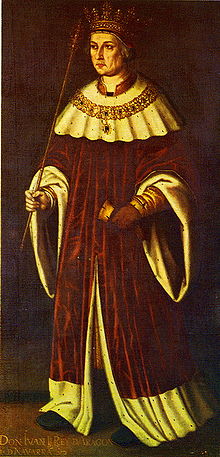
[January 20] Juan II, king of Aragón

Parents: Ferdinand I, king of Aragón, and Eleanor of Alburquerque
Date of Birth: 29 June 1398
Royal House: Trastámara
Spouse: Blanche I, queen of Navarre, then Juana Enríquez
Reign: 1458 – 1479
Predecessor: Alfonso V
Summary: John II began ruling Aragón at an early age. During his youth, he ruled in the name of his brother, Alfonso, who was generally in Italy ruling over Sicily. In 1425, he also came into possession through marriage of the small kingdom of Navarre in the Pyrenees. Throughout his life, he would reign over this small kingdom despite the superior claims of his children over his own claim. From 1441 until his own death in 1479, John deprived the right to rule Navarre first of his son, the titular Charles IV, and then Blanche II, until Queen Eleanor finally outlived her father. This conflict between father and children was not helped by John's second wife, Juana, who sowed seeds of conflict between John and the children of his first marriage. It is thought that Juana herself may have been responsible for the death of Charles IV.

As king of Aragón, John also ruled the Catalan counties of northern Spain, the kingdoms of Sicily, Valencia, Majorca, and Sardinia, and the county of Roussillon in France. Conflicts over Roussillon, technically a French county, caused John to finally cede it to Louis XI in 1472. This did not pacify him, however, and he fought a long war with France over the Catalan counties until his death in 1479. Prior to his death, John had arranged the marriage between his only surviving son, Ferdinand II, and the heiress of Castile, Isabella. Isabella became queen in 1474 and Ferdinand succeeded his father in 1479, thereby uniting for the first time in history the kingdoms of Aragón and Castile (and their many appendages), setting the groundwork for the creation of the kingdom of Spain. John's daughter Eleanor ruled Navarre for all of two weeks before dying. The Navarrese crown then passed to John's great-grandson Francis Phoebus, count of Foix.
Date of Death: 20 January 1479
Successor: Ferdinand II

Other Monarchs Who Died Today:
  • Fabian, pope of Rome (250)
  • Frederick VI, duke of Swabia (1191)
  • Rudolf II, Holy Roman Emperor (1612)
  • Charles IV, king of Spain (1819)
  • Minh Mang, emperor of Vietnam (1841)
  • Christian VIII, king of Denmark (1848)
  • Kalakaua, king of Hawai'i (1891)
  • George V, king of the United Kingdom (1936)

Thursday, January 19, 2012

[January 19] Dagobert I, king of the Franks

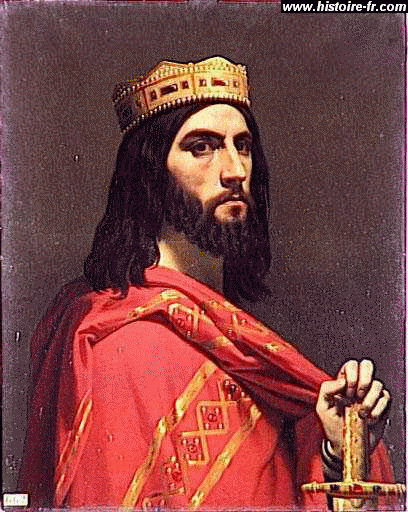
A posthumous portrait of Dagobert I from 1842.
Parents: Chlothar II, king of the Franks, and Haldetrude
Date of Birth: 603
Royal House: Merovingian
Spouse: Gormatrude, then Nanthild
Reign: 629 – 634
Predecessor: Chlothar II
Summary: Gallic politics in the 7th century were very odd. Gaul was divided, at times, into four regions. The largest and most enduring of the two were Neustria and Austrasia. Whenever an heir came of age, the nobles of Gaul would force the Frankish king to divide the kingdom between himself and his son. And thus Dagobert, in 623, was given the title "king of Austrasia" which means "King of the East Lands" in Frankish. Today, those lands comprise up to half of Germany, all of the Low Countries, and large swaths of north-eastern France. When Chlothar II died, Dagobert inherited the entire kingdom. His younger brother, Charibert, claimed Neustria (northwestern France) but Dagobert gave him Aquitaine (southwestern France) instead. In 632, his brother died and Dagobert became the uncontested king of All the Franks, ruling a state that included everything from the Pyrenees past the Rhine, and into modern-day Italy in the south.

As his first order of business, he placed his own son, Sigebert III, on the throne of Austrasia as his own father had done for him. But there was a difference. Sigebert was only three at the time of his enthronement and Dagobert still ruled de facto for another 15 years. Dagobert made Paris his capital city, being located in Neustria near the Austrasian border. He also was responsible for the construction of Saint Denis Basilica, whereafter most French royalty would be interred. Dagobert died in 634 as the last adult Merovingian monarch with any real political power. Upon his death, Sigebert became uncontested ruler of Austrasia while an infant son, Clovis II, ruled Neustria and Burgundy (southeastern France). For the next hundred years, the Merovingian dynasty would stagnate as each successive monarch would only live long enough to produce a son, and then die, leaving the government in the hands of the noble Carolingian family. Dagobert himself had to deal with this faction, led at the time by Pepin of Landen, when he appointed Sigebert to the Austrasian throne, but he retained his power until his death. Never again would a Merovingian monarch be capable of holding such authority in Gaul.
Date of Death: 19 January 639
Successor: Theuderic III

Other Monarchs Who Died Today:
  • Maharana Pratap, lord of Mewar (1540)

Labels

[brief] (102) female monarch (31) Capet (26) [abbreviated] (19) Roman Empire (17) Great monarchs (16) Japan (15) Papacy (15) England (13) saints (13) France (11) Portugal (11) [Missing Deaths] (11) Habsburg (10) Sweden (10) Byzantine Empire (9) Carolingian (9) China (9) Hohenzollern (9) Oldenburg (9) Holy Roman Empire (8) Japan (dynasty) (8) Aragón (7) Austria (7) Denmark (7) Electorate (7) Ethiopia (7) Hungary (7) Navarre (7) Norway (7) Romanov (7) Russia (7) Saxony (7) Scotland (7) Wettin (7) Wittelsbach (7) Bavaria (6) Burgundy (6) Egypt (6) Italy (6) Lorraine (6) Luxembourg (6) Persia (6) Poland (6) Sicily (6) Spain (6) Valois (6) Capet-Burgundy (5) Franks (5) Germany (5) Plantagenet (5) Prussia (5) Quraish (5) Solomon (Ethiopia) (5) Tuscany (5) Anjou (4) Aquitaine (4) Barcelona (dynasty) (4) Bohemia (4) Brittany (4) Burgundy-Aviz (4) Burma (4) Capet-Valois (4) Castile (4) Constantinople (Patriarchate) (4) Habsburg-Lorraine (4) Holstein-Gottorp-Romanov (4) India (4) Ireland (4) Jerusalem (4) Jiménez (4) Kiev (4) Mongolia (4) Naples (4) Netherlands (4) Normandy (4) Osman (4) Ottoman (4) Palaeologos (4) Savoy (4) Savoy (dynasty) (4) Trastámara (4) Wales (4) Afghanistan (3) Albania (3) Bagrationi (3) Banu Hashim (3) Blois (3) Borjigin (3) Bourbon (3) Brabant-Hesse (3) Brandenburg (3) Capet-Bourbon (3) Cologne (3) Croatia (3) Cyprus (3) Disney (3) Fairhair (3) Georgia (3) Gwynedd (3) Hainaut (3) Hesse (3) Hohenstaufen (3) Holland (3) Holstein-Gottorp (3) Inca (3) Islam (3) León (3) Limburg (3) Lithuania (3) Livonia (3) Lothier (3) Macedonia (dynasty) (3) Mainz (3) Mann (3) Medici (3) Morocco (3) México (3) Nassau (3) Nguyễn (3) Serbia (3) Stuart (Stewart) (3) Toungoo (3) Tudor (3) Turkey (3) Vaudemont (3) Vietnam (3) Welf (3) Wessex (3) published articles (3) Abberfraw (2) Aberffraw (2) Alexandria (patriarchate) (2) Angevins (2) Anglo-Saxon (2) Ardennes-Metz (2) Auvergne (2) Ayyubid (2) Basarab (2) Bernadotte (2) Billung (2) Boulogne (2) Brabant (2) Bruce (2) Burgundy-Bragança (2) Caliphate (2) Cilicia (2) Constantine (2) Crovan (2) Denmark (Dynasty) (2) Draculesti (2) Dreux (2) Dunkeld (2) Dutch Republic (2) Estridsen (2) Flanders (2) Florence (2) Further Austria (2) Greece (2) Habsburg-Spain (2) Hanover (2) Hardrada (2) Hauteville (2) Hawai'i (2) Ivrea (2) Joseon (2) Karadordevic (2) Konbaung (2) Korea (2) Maya (2) Merovingian (2) Milan (2) Ming (2) Monaco (2) Nassau-Orange (2) Nassau-Weilburg (2) Norman (2) Novgorod (2) Orange (2) Ottonian (2) Piast (2) Piedmont-Savoy (2) Poitiers (dynasty) (2) Robertian (2) Romania (2) Rurik (2) Sardinia (2) Saxe-Coburg-Gotha (2) Seljuk (2) Siam (2) Syria (2) Teutonic Knights (2) Thailand (2) Theodosian (2) Thuringia (2) Timurid (2) Tokugawa (2) United Kingdom (2) Valois-Burgundy (2) Vandal (2) Venice (2) Visconti (2) Vladimir (2) Wallachia (2) Württemberg (2) York (2) Yugoslavia (2) Zeeland (2) the Britons (2) 18th Dynasty (Egypt) (1) Abbasid (1) Adal (1) Agiad (1) Akinyele (1) Al Khalifa (1) Al-Said (1) Alawiyya (Egyptian) (1) Albret (1) Algeria (1) Algonquian (1) Amber (1) Angola (1) Anjou (dynasty) (1) Anjou-Hungary (1) Ansbach (1) Antonia (1) Antonine (1) Apulia (1) Arabia (1) Armenia (1) Arpad (1) Arsacid (1) Asen (1) Ashikaga (1) Athens (1) Avesnes (1) Avignon Papacy (1) Aviz-Beja (1) Aztec Empire (1) Baden (1) Bahrain (1) Balti (1) Barakzai (1) Barazkai (1) Barcelona (1) Battenberg (1) Belgium (1) Bengal (1) Berg (1) Berg (dynasty) (1) Bernicia (1) Bharatpur (1) Bhutan (1) Bjelbo (1) Bonaparte (1) Bonde (1) Bonngau (dynasty) (1) Borghese (1) Borja (1) Bosnia (1) Bourbon-Two Sicilies (1) Brandenburg-Ansbach (1) Brienne (1) Brutus (1) Bukhara (1) Bulgaria (1) Canossa (1) Capet-Dreux (1) Carthage (1) Celje (1) Celje (dynasty) (1) Chakri (1) Champagne (1) Champagne (dynasty) (1) Chartres (1) Cometopuli (1) Contantine (1) Cordoba (1) Craiovesti (1) Crusader States (1) Dalmatia (1) Damascus (1) Danesti (1) Debeubarth (1) Deira (1) Deira (dynasty) (1) Denmar (1) Dulo (1) Díaz (1) Early Han (1) East Anglia (1) East Francia (1) Eastern Han (1) Eastern Jin (1) Egmont (1) Estonia (1) Farnese (1) Fatimid (1) Fatimid Caliphate (1) Flanders (dynasty) (1) Flavian (1) Friuli (1) Gausi (1) Geneva (1) Geneva (dynasty) (1) Gordiani (1) Grimaldi (1) Guelders (1) Guideschi (1) Gwent (1) Gwynedd (dynasty) (1) Gyatso (1) Haag (1) Hainaut (dynasty) (1) Hanan Cuzco (1) Hashim (1) Hashimite (1) Hebrides (The Isles) (1) Hellenes (1) Herat (1) Hohenzollern-Ansbach (1) Hohenzollern-Sigmaringen (1) Holland (dynasty) (1) Hunfriding (1) Ibadan (1) Iran (1) Iturbide (1) Jaipur (1) Jin (1) Jordan (1) Julio-Claudian (1) Jungingen (1) Justinian (dynasty) (1) Kachwaha (1) Kalakaua (1) Kamehameha (1) Karrani (1) Kent (1) Kent (house) (1) Kestutis (1) Khurasan (1) Knights Templar (1) Komnenos (1) Kotromanić (1) Lakota Sioux (1) Lancaster (1) Latin Empire (1) Lebanon (1) Leuchtenberg (1) Lombards (1) Ludowinger (1) Lusignan (1) Luxembourg (dynasty) (1) Luxembourg-Limburg (1) Maan (1) Macedon (1) Magdeburg (1) Maine (1) Majorca (1) Malaysia (1) Manghit (1) Maratha Empire (1) Marinid (1) Matsunaga (1) Maurya (1) Mecklenburg (1) Mecklenburg-Strelitz (1) Meissen (1) Mercia (1) Mercia (dynasty) (1) Miniconjou (1) Moldavia (1) Montenegro (1) Montferrat (1) Morgannwg (1) Mortain (1) Mountbatten (1) Mughal (1) Muhammad Ali (1) Munster (1) Musat (1) Myanmar (1) Nakagawa (1) Ndongo and Matana (1) Nemanjic (1) Nepal (1) Nervo-Trajan (1) Neuchâtel (1) Nigeria (1) Nominoë (1) Northumbria (1) O'Brien (1) Obrenović (1) Odowa (1) Olgovich (1) Olympus (1) Orléans-Longueville (1) Ostrogoths (1) Ottawa (1) Pahlavi (1) Palatinate of the Rhine (1) Parma (1) Penthièvre (1) Petrović-Njegoš (1) Poděbrady (1) Pointiers (Ramnulfids) (1) Poitiers (1) Poitiers-Lusignan (1) Polignac (1) Powys (1) Prasat Thong (1) Premyslid (1) Provence (1) Přemyslid (1) Q'umarkaj (1) Qin (1) Qing (Manchu) (1) Reginar (1) Reginarid (1) Rethel (1) Rethel-Boulogne (1) Ribagorza (1) Rouergue (1) Roupenians (1) Sa Malietoa (1) Safavid (1) Salian (1) Salzburg (1) Samoa (1) Sarantapechos (1) Saud (1) Saudi Arabia (1) Second Triumvirate of Rome (1) Selangor (1) Selangor (dynasty) (1) Sforza (1) Shah (Nepal) (1) Shi'a Imamate (1) Shishman (1) Shivaji (1) Silesia (1) Simmern (1) Sinsinwar Jat (1) Skowronski (1) Slovenia (1) Sobieski (1) South Africa (1) South America (1) Sparta (1) Spoleto (1) Sture (1) Sudan (1) Sussex (1) Sverre (1) Swabia (1) Swasi (dynasty) (1) Swaziland (1) Swiss Confederation (1) Tang (1) Tenochtitlan (1) Teotihuacán (1) Terter (1) Tibet (1) Tikal (1) Tolkien (1) Toulouse (1) Tours (dynasty) (1) Transylvania (1) Tunisia (1) Umayyad (1) Unruoching (1) Valencia (1) Valois-Angoulême (1) Valois-Anjou (1) Valois-Orléans (1) Vasa (1) Vermandois (1) Visigoths (1) Vokil (1) Wangchuck (1) Wied-Neuwied (1) Windsor-Mountbatten (1) Württemberg (dynasty) (1) Yamato (1) Ying (Qin) (1) Yuan (1) Zanzibar (1) Zhao (Song) (1) Zhou (1) Zhu (1) Zogu (1) Zulu Nation (1) Zápolya (1) Zähringen (1) bretwalda (1) cardinal (1) fantasy (1) fiction (1) shogunate (1) terms (1) Árpád (1) Öuchi (1)